
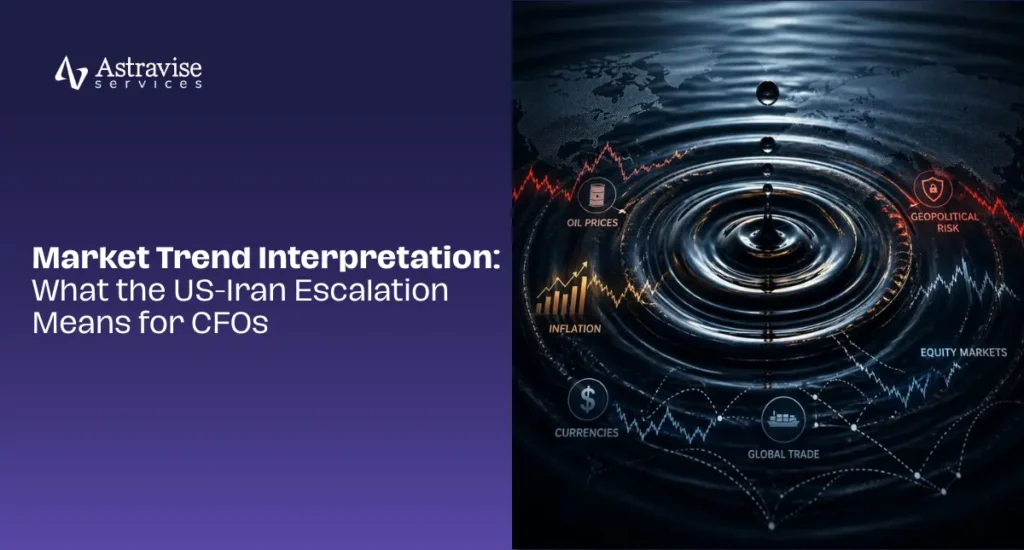
A structured view of the ripple effects, and what finance leadership needs to be doing now
The convergence CFOs are navigating
The escalation between the US and Iran in 2025 arrived as a convergence; a demand shock, a supply chain disruption, an energy price event, and a capital markets repricing, all at once.
Events of this nature don’t move through an economy in sequence. They compound. And the CFOs who understand that compounding early are the ones making decisions with a structural advantage over those waiting for conditions to stabilize.
This blog breaks down how that compounding moves across three distinct time horizons, and what it means for how finance leadership should be operating right now.
The Ripple Effect: Three Waves, Three Sets of Decisions
- First Ripple — Immediate Impact (0–3 months)
The Strait of Hormuz carries approximately 20% of global oil supply. Any sustained tension in that corridor translates directly into energy price movement — and energy price movement translates into cost pressure across manufacturing, logistics, aviation, and any business with significant energy intensity in its operating model.
In the immediate window, CFOs are dealing with currency volatility, equity market repricing, and rising input costs — often simultaneously. The analytical challenge at this stage is separating temporary price spikes from structural cost shifts.
Organisations that treat a structural shift as temporary hold capital allocation and hedging positions that are no longer aligned to the actual risk environment. Those that overreact to a temporary spike restructure supply chains and adjust pricing at a cost that the market doesn’t sustain. Both carry consequences that compound into the next wave. - Second Ripple — Medium Term Adjustment (3–12 months)
Annual forecasts built on pre-escalation assumptions are already structurally compromised.
As energy costs embed into supply chains, inflation follows, and central banks face a difficult position. Raising rates to control inflation risks slowing growth. Holding rates risks letting inflation run. Either path has direct implications for borrowing costs, capital availability, and investment decisions.
In parallel, trade routes restructure. Businesses with Middle East-adjacent supply chain dependencies are already mapping alternative corridors. That restructuring carries its own cost – in time, in logistics spend, and in the management bandwidth required to execute it.
For CFOs, the medium-term window is where scenario planning earns its value. The organisations moving to rolling 90-day financial visibility with defined trigger points are operating with considerably more decision-making agility than those waiting for conditions to stabilise before updating their forecasts. - Third Ripple: Long Term Structural Shift (12 months+)
The long-term effects of sustained geopolitical tension are structural, and they move quietly.
Supply chain geography shifts permanently. Institutional capital begins pricing geopolitical risk as a fixed variable. Energy infrastructure investment accelerates in non-exposed geographies. New trade alliances form around supply security rather than cost efficiency alone.
For CFOs, this is the horizon where capital allocation decisions carry the most weight.
Consider a mid-sized manufacturer with 60% of its component supply routed through Gulf-adjacent corridors. A CFO who reassesses that exposure now – mapping alternative sourcing in Southeast Asia or Eastern Europe, building currency hedging positions around the new corridors, and adjusting long-range capex accordingly – is making a set of decisions that compound in value as the structural shift deepens.
Two years from now, that recalibration looks like foresight. Executed under pressure, it looks like an expensive restructuring.
Pricing geopolitical risk into long-range models is no longer a scenario planning exercise. For businesses with material exposure to this corridor, it is a capital allocation decision with a timeline.
What This Means for Financial Planning
Most financial models are built for conditions that move sequentially and independently. Energy costs rise, then inflation follows, then interest rates respond, each variable moving on its own timeline.
The US-Iran escalation is producing a different dynamic. Energy, inflation, interest rates, and supply chain costs are moving together, and each is influencing the others. That non-linear compounding is where conventional forecasting frameworks lose resolution.
The CFOs navigating this well are doing three things differently:
- Building scenario structures for compounding, not sequences
Rather than modelling each variable independently, they are mapping how combinations of outcomes interact, and identifying the trigger points that shift the organisation from one scenario to another. - Updating frameworks as conditions evolve
Scenario planning built once at the start of the year and revisited at the next planning cycle is not fit for this environment. The analytical infrastructure needs to be built for iteration – updated as signals shift, not reconstructed from scratch each quarter. - Positioning finance as a real-time strategic input
The value of the CFO function in this environment is not in reporting what happened last quarter. It is in informing what the organisation should do in the next 90 days, with clarity on the assumptions behind those recommendations and the conditions under which they would change.
Where Finance Leadership Is Recalibrating
Across the organisations thinking carefully about this, several areas of recalibration are consistently emerging:
- Energy cost exposure
Mapping direct and indirect exposure across the full supply chain, not just at the top line. Brent crude rose approximately 15% in the weeks following the escalation — and for businesses with significant logistics, manufacturing, or distribution operations, second and third-tier energy exposure is often larger than the direct line item suggests. The IMF estimates that a 10% sustained rise in oil prices reduces global GDP growth by 0.15 percentage points — a figure that scales considerably for energy-intensive sectors. (Source: IMF World Economic Outlook, 2024) - Capital allocation
Rebalancing liquidity positions given sustained uncertainty in commodity and currency markets. JP Morgan’s 2024 CFO survey found that 67% of CFOs increased their cash reserves in response to geopolitical uncertainty – with the average liquidity buffer rising from 8 weeks to 14 weeks of operating expenses across mid-market businesses. (Source: JP Morgan CFO Sentiment Survey, 2024) - Vendor and supply chain mapping
Identifying dependencies in Middle East-adjacent corridors at the second and third-tier level. The World Bank estimates that approximately 30% of global trade passes through Gulf-adjacent shipping lanes. Primary supplier relationships are generally well understood — the exposure further down the chain is where concentration risk tends to surface. (Source: World Bank Trade Report, 2023) - Hedging positions
Reassessing currency and commodity hedging strategies as geopolitical risk reprices. According to the Association for Financial Professionals, hedging programme reviews typically lag market events by 60 to 90 days — a window during which unhedged exposure can move materially. Positions built on pre-escalation volatility assumptions require active reassessment, not periodic review. (Source: AFP Risk Management Survey, 2023)
The CFO Function in This Environment
The geopolitical shifts of 2025 are not a planning disruption. They are a stress test of whether the finance function was built for the environment it is now operating in.
The CFOs who come out of this period with strategic credibility intact will be the ones who treated market interpretation as a core capability, not a quarterly exercise.
Astravise Services works with finance and leadership teams to build the scenario frameworks, analytical structures, and strategic advisory capability that translate market signals into informed financial decisions, in environments where conditions are moving faster than conventional planning cycles were designed to handle.
For CFOs navigating the current environment, the conversation worth having is not about what happened last quarter. It is about what the next 90 days require.