

1. Introduction – The Shift in Startup Hiring
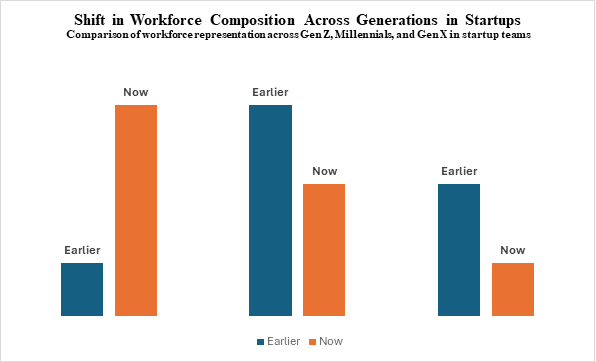
Across startup ecosystems worldwide, team composition is changing rapidly. Many early-stage companies today are staffed largely by Gen Z and early-career professionals, resulting in a noticeable decline in the average workforce age within startup teams.
This shift is not incidental.
As Gen Z enters the workforce at scale, the available talent pool itself is becoming younger particularly in technology-driven sectors where startups are most active.
For startups navigating fast-changing markets, this trend often appears practical. Younger professionals are perceived as agile learners, comfortable with emerging technologies, and capable of adapting quickly to evolving roles.
An important hiring pattern is also becoming evident. In several early-stage startups, even when experienced professionals from Millennial or Gen X backgrounds apply, hiring decisions often lean toward younger, early-career candidates.
This trend raises an important question for founders, leaders, and workforce strategists:
As startups increasingly build younger teams, where does experience fit into the modern startup workforce?
Understanding this requires examining both the startup environment and broader workforce trends shaping hiring decisions today.
2. The Startup Operating Environment
Startups operate under conditions very different from traditional enterprises.
Early-stage companies typically face three structural realities:
- Financial Constraints Before stable revenue or later funding rounds, startups must manage burn rates carefully and operate with lean teams.
- Speed of Execution Product cycles are short, experimentation is constant, and teams must respond quickly to customer feedback.
- Fluid Roles Employees frequently operate across multiple functions—from product development and marketing to operations and customer engagement.
These conditions naturally influence how startup founders evaluate talent.
The rapid expansion of the startup ecosystem further intensifies this dynamic. “According to the Department for Promotion of Industry and Internal Trade (DPIIT), India now has more than 100,000 recognized startups, making it one of the largest startup ecosystems in the world. Collectively, these startups employ over 600,000 professionals, and the number continues to grow as new ventures emerge across
sectors such as fintech, SaaS, health tech, and e-commerce. *Source: Department for Promotion of Industry and Internal Trade (DPIIT)
Within such environments, companies often prioritize talent that can learn quickly, adapt to multiple roles, and operate comfortably in fast-moving teams.
3. Why Gen Z Talent Is Becoming Central to Startup Teams
Several factors explain why Gen Z professionals are increasingly visible within startup teams.
Cost Efficiency Early-stage companies often operate with limited resources, and hiring early-career professionals allows founders to build teams while maintaining lean cost structures.
Learning Agility Startup environments change quickly. Gen Z professionals often demonstrate strong adaptability and willingness to acquire new skills rapidly.
Digital-Native Capabilities Having grown up in a technology-driven environment, Gen Z professionals tend to be comfortable with digital tools, collaboration platforms, and emerging technologies.
Research from the Deloitte Gen Z and Millennial Survey indicates that nearly 85% of Gen Z professionals actively use digital collaboration tools or emerging technologies such as AI in their work or learning environments.
These characteristics align closely with the needs of fast-moving startup organizations.
Skill development patterns reinforce this trend. Workforce surveys show that over 60% of Gen Z professionals actively pursue upskilling in areas such as artificial intelligence, data analytics, and digital platforms, reflecting a strong focus on continuous learning.
Cultural alignment can also influence hiring patterns. Many startup founders themselves belong to younger generations, and shared generational experiences can shape team dynamics, communication styles, and working preferences.
Together, these factors contribute to the growing presence of Gen Z professionals within startup organizations.
4. Industry Observation and Hiring Trends
This shift is also reflected in broader workforce and hiring trends The rise of Gen Z in startups is also part of a broader transformation in global workforce demographics and talent supply.
4.1 Workforce Demographic Shift
Research indicates that Millennials and Gen Z together now account for nearly two-thirds of the global workforce, reflecting a major generational transition across industries.
Gen Z alone represented approximately 27% of the global workforce in 2025, according to workforce projections.
4.2 Gen Z Entry into the Workforce
Studies imply that around 26% of Gen Z professionals in India begin working or gaining professional experience while still pursuing their academic programs, enabling them to build practical experience earlier than many previous generations through Internships, freelance work, and project-based opportunities.
4.3 Skill and Technology Trends
Research shows that 85% of Gen Z professionals actively engage in continuous learning and skill development, particularly in areas such as AI, digital platforms, and automation technologies.
4.4 Talent Market Dynamics
The supply of talent in the job market also plays a role in shaping hiring patterns.
Workforce surveys indicate that approximately one-third of Gen Z professionals are actively seeking employment opportunities at any given time, particularly within technology and digital-driven sectors.
The availability of this large and active talent pool naturally influences hiring patterns in fast-growing organizations.
5. The Strategic Value of Experience in Startups
While younger professionals bring energy, adaptability, and technological familiarity, experience remains a critical factor in the long-term success of growing organizations.
However, as startups move from experimentation to scale, the challenges they face begin to change. The question then shifts from speed of execution to sustainable growth and organizational stability.
At this stage, experience becomes a powerful strategic asset.|
One of the most important contributions of experienced professionals lies in strategic decision-making. Individuals who have navigated multiple business environments often develop the ability to evaluate long-term implications, assess risk, and guide organizations through uncertainty.
Experience also supports risk management and operational stability. Startups frequently encounter market volatility, regulatory challenges, and operational bottlenecks. Professionals with industry exposure can help anticipate potential disruptions and design structured responses.
Another key contribution is industry relationships and networks. Experienced professionals often bring established connections across suppliers, partners, investors, and clients. These relationships can accelerate partnerships, strengthen business development efforts, and improve market access.
In addition, experienced professionals frequently play an important role in building organizational processes and governance frameworks. As startups grow, operational discipline becomes essential. Processes, compliance structures, and leadership frameworks help translate early innovation into sustainable organizational capability.
In this sense, while youth often fuel experimentation and rapid iteration, experience enables scalability and long-term resilience.
Several scaling startups have demonstrated the importance of integrating experienced leadership as they grow. Companies such as Flipkart, Zomato, and Freshworks have progressively strengthened their leadership teams with seasoned professionals across operations, finance, and strategy as they transitioned from early-stage experimentation to large-scale operations.
This shift has enabled them to build stronger governance frameworks, improve operational efficiency, and navigate complex market dynamics more effectively. Their journeys highlight that while early growth may be driven by agility and experimentation, sustained scale often requires the depth of experience that seasoned professionals bring.
6. Leadership Insight: The Multi-Generational Workforce Advantage
From a leadership perspective, the question is not Gen Z versus experienced professionals.
The more relevant question is how different generations contribute complementary strengths.
Gen Z contributes digital fluency, curiosity, and rapid experimentation.
Millennials often bridge innovation and execution, combining operational leadership with technological familiarity.
Gen X frequently brings strategic depth, industry networks, and long-term perspective.
Research consistently shows that diverse teams, including generational diversity – demonstrate stronger problem-solving and more balanced decision-making.
For startups transitioning from experimentation to scale, this diversity can become a significant advantage. Organizations that combine innovation with experience often build teams that are both agile and resilient.
7. ASPL’s Perspective on Workforce Strategy
At Astravise Services (ASPL), workforce strategy is approached through capability design rather than generational preference.
In startup environments, different stages of growth require distinct capabilities, and these often align with varying levels of experience.
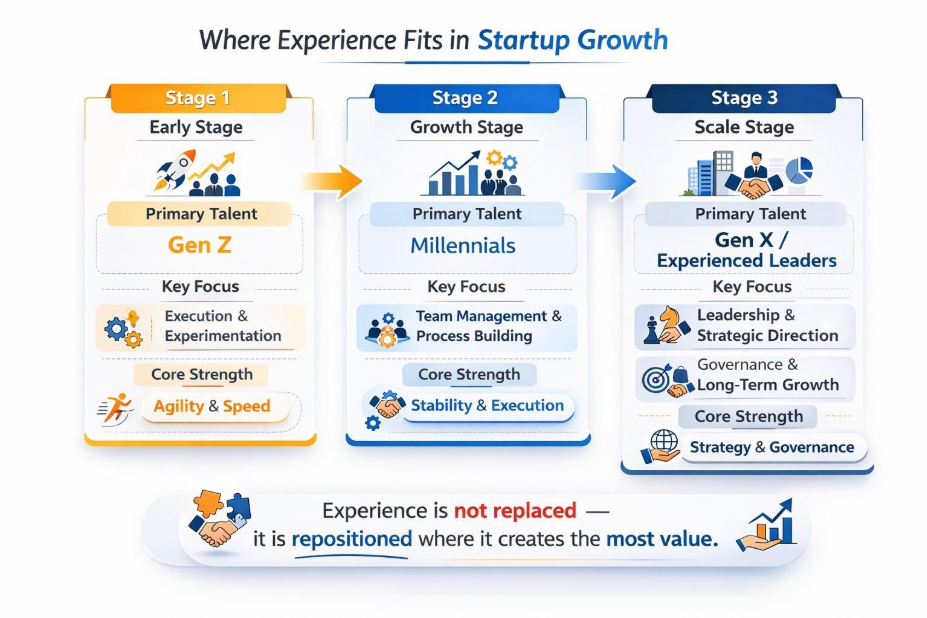
In early-stage operations, roles focused on execution, experimentation, and rapid iteration are typically driven by early-career professionals, who bring adaptability and digital fluency.
As organizations begin to scale, the focus shifts toward structured execution, team coordination, and process alignment. At this stage, mid-level professionals play a critical role in bridging day-to-day operations with emerging strategic priorities.
At more advanced stages, where organizations face increased complexity in decision-making, risk management, and expansion, experienced professionals become essential. Leadership roles such as directors, functional heads, and strategic advisors contribute to long-term planning, governance, and organizational stability.
This progression highlights a key principle: experience is not replaced in startup environments it is repositioned where it creates the most value.
ASPL works with organizations to design balanced talent structures, ensuring that:
- early-career talent drives agility and execution
- Mid-level professionals enable operational consistency
- Experienced leaders provide strategic direction and oversight
Such an approach enables organizations to move beyond reactive hiring and build integrated, multi-layered teams that support both innovation and long-term scalability.
8. Conclusion – Rethinking Talent Strategy in the Startup Era
The growing presence of Gen Z professionals in startup teams reflects broader shifts in workforce demographics, technology adoption, and talent supply. Younger professionals often bring agility, digital fluency, and adaptability, i.e. qualities well suited to early-stage experimentation.
Yet as startups scale, the value of experience becomes increasingly visible. Strategic decision-making, operational discipline, and industry insight often become essential capabilities during the growth phase.
The most resilient organizations therefore do not choose between innovation and experience. They build teams where both reinforce each other.
In the evolving startup economy, the future of talent strategy may lie in integrating generations rather than prioritizing one over another.