
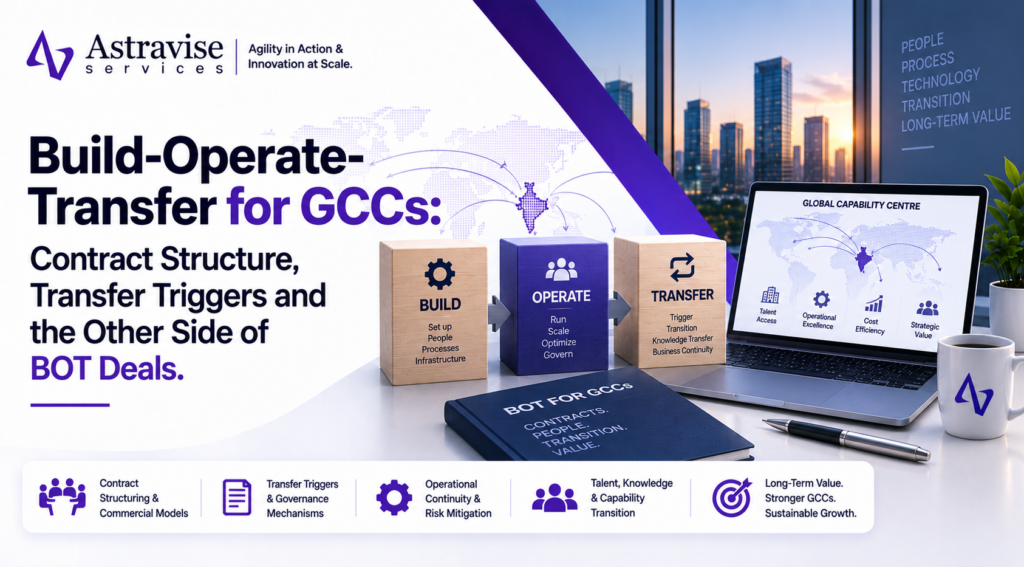
A Build-Operate-Transfer (BOT) contract for a Global Capability Centre is not an outsourcing agreement with an exit clause bolted on. It is an M&A transaction signed two to four years before it closes, and the clauses that decide whether the transfer happens are rarely the ones negotiated hardest at signing. Three Indian regimes govern that closing: Rule 21 of the Foreign Exchange Management (Non-Debt Instruments) Rules, 2019 on price, Section 77 of the Income-tax Act, 2025 on tax, and Section 73 of the Industrial Relations Code, 2020 on people.
TL;DR: A built GCC changes hands one of two ways, a share purchase of the vendor’s SPV or a slump sale of the undertaking, and the route drives tax, stamp duty and liability. The transfer price cannot be fixed at signing, because Rule 21(2)(b) requires a resident-to-non-resident share transfer to be priced at not less than fair market value certified at the time of transfer. Section 73 of the Industrial Relations Code, in force since 21 November 2025, entitles every worker with one year of continuous service to retrenchment-equivalent compensation on a transfer of ownership unless three conditions are written into the contract. From Tax Year 2026-27 the transferred entity becomes an associated enterprise under a new safe harbour margin of 15.5% of operating expenses.
India hosts 2,117 Global Capability Centres across 3,728 units, generating USD 98.4 billion and employing 2.36 million people, per the Zinnov-nasscom GCC Landscape in India 2026 report, data as of March 2026. A meaningful share started life inside somebody else’s entity, which means a meaningful share have a transfer ahead of them, or have already fumbled one.
What a Build-Operate-Transfer GCC Contract Actually Is
Build-Operate-Transfer is a phased entry model in which a third-party provider incorporates, staffs and runs a capability centre on the client’s behalf for a defined period, after which legal ownership and operational control pass to the client. Whether BOT is the right model at all is a separate decision, set out in our guide to choosing the right GCC engagement model. This piece assumes that decision is taken. Three things BOT contracts routinely blur are worth stating precisely.
-
Legal ownership during the operate phase. The provider either incorporates a dedicated Indian private limited company, or runs the team inside its own entity as a ring-fenced unit. The first transfers by share sale. The second cannot, and must first be carved out as an undertaking, which is a materially harder transaction with different tax consequences.
-
Who employs the people. During the operate phase the employees sit on the provider’s payroll. At transfer they move, and that movement is a statutory event, not an administrative one.
-
Who owns the intellectual property built in the interim. Code, process documentation, tooling and data models are created by the provider’s employees. Absent an express present assignment, ownership does not simply follow the transfer.
Our guide to setting up a GCC in India in 2026 covers the build. The rest of this piece is about the exit.
Why the Transfer Price Cannot Be Fixed at Signing
This is the most common defect in BOT term sheets, and it is usually introduced by the buyer, who quite reasonably wants price certainty on a multi-year commitment. In the standard structure the provider’s Indian entity is resident and the acquiring client is non-resident, making this a resident-to-non-resident transfer under Rule 21(2)(b) of the NDI Rules, notified 17 October 2019. For an unlisted Indian company the price shall not be less than fair market value, determined by an internationally accepted pricing methodology on an arm’s length basis and certified by a Chartered Accountant, a SEBI-registered Category I Merchant Banker, or a practising Cost Accountant.
Read that as a floor, not a formula. Fix a rupee price at signing, and if certified fair market value at transfer comes out higher, the transfer as agreed is not compliant. The buyer pays more, or the deal reopens.
The mirror structure has the opposite problem. Where the exiting party is the non-resident, the Explanation to Rule 21(2)(c)(iii) provides that a person resident outside India is not guaranteed any assured exit price at the time of making the investment or agreement, and shall exit at the price prevailing at the time of exit. Pre-agreed prices, floor prices and IRR-linked prices are impermissible there whatever they are called.
There is also a shelf-life problem specific to BOT. A valuation prepared at entry cannot serve as the exit valuation, and authorised dealer banks in practice look for one dated within roughly six months of transfer. On a three-year BOT, the signing-date valuation is worthless paper by the time it is needed.
The drafting answer is a mechanism, not a number: agreed methodology, an appointing authority for the valuer, a timetable, and a price corridor with a walk-away right if the certified value falls outside it. Form FC-TRS then follows within 60 days of the transfer or receipt of consideration, whichever is earlier.
Share Purchase or Slump Sale: The Two Routes and What Each Costs
The Income-tax Act, 1961 stood repealed on 1 April 2026 and the Income-tax Act, 2025 now governs, so any BOT contract drafted earlier carries stale statutory references on precisely this point.
| Dimension | Share purchase of the SPV | Slump sale of the undertaking |
|---|---|---|
| What moves | Shares in the Indian company; the entity survives intact | The business as a going concern, with scheduled assets and liabilities |
| Governing provision | Capital gains for the seller; FEMA Rule 21 pricing applies | Section 77, Income-tax Act, 2025, replacing Section 50B of the 1961 Act |
| Gain computed as | Consideration less cost of acquisition | Fair market value deemed full value of consideration, less statutory net worth |
| Mandatory certification | Rule 21 valuation by CA, Category I Merchant Banker or Cost Accountant | Accountant’s report under Section 77(4), before the specified date in Section 63 |
| Stamp duty | 0.015% of consideration, uniform across states since 1 July 2020 | State ad valorem duty on the business transfer agreement, materially higher where immovable property is involved |
| GST | Outside GST | Nil-rated as transfer of a going concern, Entry 2 of Notification 12/2017-Central Tax (Rate) |
| Liabilities | Buyer inherits the entity’s full history, tax and litigation included | Only scheduled liabilities move, but both parties are jointly and severally liable for tax on the business transfer |
| Timeline | Faster, provided the shares are already dematerialised | Slower; asset schedules, consents and novations drive the clock |
Two operational traps sit inside that table.
The first is dematerialisation. Under Rule 9B of the Companies (Prospectus and Allotment of Securities) Rules, 2014, every private company other than a small company must issue and hold securities in dematerialised form, the compliance deadline having passed on 30 June 2025. A small company means paid-up capital not exceeding INR 4 crore and turnover not exceeding INR 40 crore. Any SPV holding a GCC of consequence is past those thresholds. Without an ISIN the shares cannot be transferred, and obtaining one is not a same-week exercise.
The second is net worth. Section 77(5) preserves the rule that net worth is aggregate book value of assets less liabilities, with revaluation ignored. A provider that revalues assets before handover to improve the optics achieves nothing for tax and creates a diligence question it then has to answer.
Transfer Triggers: Which Ones Hold and Which Ones Fail
A transfer trigger is the contractual event that entitles or obliges a party to initiate handover. Four work. Two are why BOT deals end up in arbitration.
-
Fixed-date trigger. The window opens on a stated calendar date, typically 24 to 36 months after go-live. It is the cleanest because it is not arguable, and it lets both sides calendar the valuation, the ISIN, the employee communications and the FC-TRS filing backwards from a known date. Its weakness is indifference to whether the centre is actually ready.
-
Steady-state milestone trigger. The window opens once defined conditions are met: headcount at plan, service levels held for a stated number of consecutive months, attrition below a threshold, documentation signed off. Incentives align because the provider is not paid out until the centre works, but the milestones must be measurable and independently verifiable, which is where most drafts fail.
-
Client call option. The client may require transfer any time after a lock-in, at valuation determined on exercise. Most flexible for the buyer, and compatible with the FEMA pricing regime precisely because price is set at exercise.
-
Provider put option on defined events. The provider may require the client to take the centre on a change of control, sustained non-payment or client insolvency. Buyers resist it, but it protects against a provider left holding an entity built to one customer’s specification.
The two that fail are worth naming. Price-conditional triggers, where the obligation to transfer depends on the valuation landing in an agreed band, convert a certainty into an option and invite a dispute when relations are most strained. Satisfaction-conditional triggers, where transfer occurs once the client is reasonably satisfied, hand one party a unilateral veto dressed as a standard.
Section 73 Decides Whether Your Transfer Is Free or Expensive
This is the clause most BOT contracts get wrong, and the one with the largest cash consequence. The Industrial Relations Code, 2020 came into force on 21 November 2025 via Notification S.O. 5320(E), consolidating the Industrial Disputes Act, 1947, the Trade Unions Act, 1926 and the Industrial Employment (Standing Orders) Act, 1946.
Section 73 provides that where ownership or management of an establishment is transferred, whether by agreement or by operation of law, every worker in continuous service for not less than one year immediately before the transfer is entitled to notice and compensation under Section 70 as if retrenched. Section 70 compensation is fifteen days’ average pay for every completed year of continuous service, plus one month’s notice or pay in lieu.
Then comes the proviso the whole deal turns on. Section 73 does not apply where there has been a change of employers by reason of the transfer if all three of the following hold: service has not been interrupted by the transfer; terms and conditions after the transfer are not in any way less favourable than those immediately before it; and the new employer is legally liable to pay retrenchment compensation on the basis that service has been continuous and uninterrupted.
All three must hold. Continuity of service alone is not enough. A transfer that resets tenure for gratuity, or moves people onto a leaner benefits structure to fit the acquirer’s global grade bands, fails limb (b) and reopens limb (c). At that point the acquirer is not buying a GCC. It is funding a statutory severance event across the entire workforce.
The fix is unglamorous and takes ten minutes: write the three limbs into the business transfer agreement as express covenants, annex the benefits comparison, and have the acquirer expressly assume continuity-based retrenchment liability. Then stress-test the acquirer’s own HR policy against limb (b) before signing, not during integration.
The Other Side: What Changes on Day One After You Own It
The transfer is the midpoint of the project, not the end. Four things change the morning after.
The entity becomes an associated enterprise. During the operate phase the client paid a third-party provider a commercial fee and there was no transfer pricing question. After transfer the Indian entity charges its foreign parent, and that charge must satisfy Indian transfer pricing. Different cost base, frequently a higher one than the fee it replaced.
The safe harbour regime changed underneath the model. From Tax Year 2026-27, software development, ITeS, KPO and contract R&D relating to software consolidate into a single Information Technology Services category at a uniform safe harbour margin of 15.5% of operating expenses, replacing the earlier 17% to 24% range. The threshold rose from INR 300 crore to INR 2,000 crore, the election runs as a five-year block, and it is made by filing Form 49, with the window for Tax Year 2026-27 running to 30 June 2027. Safe harbour is an election, not a default. Miss the first-year window and the block is gone.
Governance stops being the provider’s problem. Board composition, the risk library, the compliance calendar and the control environment all land on the acquirer on day one. We set out the sequence in the GCC governance blueprint, and it matters more here than in a greenfield build, because you inherit controls somebody else designed to their own standards.
Institutional knowledge sits with people who did not choose you as an employer. Everyone in that centre joined the provider. The retention question is not whether your package beats the market. It is whether it beats the provider’s counter-offer.
Eight Clauses That Decide Whether a BOT Transfer Closes
-
Valuation mechanism, not a price. Methodology, appointing authority, timetable, and what happens if certified value falls outside an agreed corridor.
-
Section 73 proviso covenants. All three limbs expressly drafted, with the benefits comparison annexed.
-
Present assignment of intellectual property. Assignment operating on creation rather than on transfer, covering code, documentation, process assets, tooling and data models, with employee assignment deeds flowing up.
-
Dematerialisation covenant. The provider undertakes to have the SPV ISIN-compliant under Rule 9B well ahead of the transfer window.
-
Transition services agreement. Twelve months is typical. Payroll, IT, facilities and statutory filings do not move cleanly on a single date.
-
Key person and non-solicit provisions. Named roles with retention obligations through the transfer, and a non-solicit that survives it with teeth.
-
Tax indemnity with full diligence access. In a share purchase you inherit everything; in a slump sale both parties are jointly and severally liable for tax on the business transfer.
-
Expert determination for valuation disputes. Faster and cheaper than arbitration, and it preserves a working relationship through a live operation.
Frequently asked questions
- What is the Build-Operate-Transfer model for a GCC?
- Build-Operate-Transfer is a phased market entry model in which a third-party provider incorporates an Indian entity, recruits the team and runs the capability centre on the client’s behalf for a defined period, usually two to three years, after which ownership and operational control transfer to the client. The client carries lower upfront commitment and reaches scale faster than with a greenfield build, while the provider carries execution risk and earns a fee through the operate phase. What distinguishes BOT from a vendor or managed-team arrangement is that ownership transfer is contractually committed from the outset rather than left as a possibility.
- How is the transfer price determined in a BOT GCC deal?
- It cannot simply be fixed at signing. Where the provider’s Indian entity is resident and the acquiring client is non-resident, Rule 21(2)(b) of the NDI Rules, 2019 requires the price for an unlisted Indian company to be not less than fair market value, certified by a Chartered Accountant, a SEBI-registered Category I Merchant Banker or a practising Cost Accountant using an internationally accepted arm’s length methodology. That valuation must be contemporaneous with the transfer, not with the signing. Where the exiting party is instead the non-resident, the Explanation to Rule 21(2)(c)(iii) prohibits any assured exit price agreed at the time of investment. In both cases, contract for a valuation mechanism with an agreed corridor rather than a number.
- Is a BOT GCC transfer done as a share sale or a slump sale?
- Both are used, and the choice follows how the centre was built. Where the provider incorporated a dedicated special purpose vehicle, a share purchase is cleaner and faster, though the acquirer inherits the entity’s entire history. Where the team sat inside the provider’s existing entity, it must be carved out and moved as an undertaking, which brings Section 77 of the Income-tax Act, 2025 into play: fair market value deemed the full value of consideration, statutory net worth as the cost base, and an accountant’s report under Section 77(4). A genuine going-concern transfer is nil-rated under Entry 2 of Notification 12/2017-Central Tax (Rate), but attracts state stamp duty that can dwarf the 0.015% payable on a share transfer.
- Do employees automatically transfer in a BOT handover?
- Not automatically, and not for free unless the contract says the right things. Section 73 of the Industrial Relations Code, 2020, in force since 21 November 2025, entitles every worker with at least one year of continuous service to notice and compensation as if retrenched when ownership or management of an establishment is transferred. The proviso disapplies that entitlement only where three conditions all hold: service is not interrupted, post-transfer terms are in no way less favourable, and the new employer is legally liable for retrenchment compensation computed on uninterrupted service. Acquirers most often trip on the second by moving people onto their own global benefits structure. The consequence is statutory severance across the whole workforce at fifteen days’ average pay per completed year.
- How long does a BOT arrangement typically run before transfer?
- Most BOT contracts set the transfer window at 24 to 36 months from go-live, reflecting how long a centre takes to reach steady state on headcount, service levels and process documentation. The more useful question is what the window is anchored to. A fixed-date trigger is unambiguous but indifferent to readiness; a steady-state milestone trigger aligns incentives better but needs measurable, independently verifiable conditions. Many well-drafted contracts combine the two, using a milestone trigger with a long-stop date after which the fixed date applies regardless. What should not be built in is a trigger contingent on the valuation landing in an agreed band.
Before You Sign
Three years is a long time in a business, and BOT contracts are usually written by people who will not be in the room at handover. That is exactly why the mechanism matters more than the number.
My own bias, after enough due diligence exercises to know where the bodies are usually buried: negotiate the exit before you negotiate the fee. The fee is a line item you will renegotiate anyway. The exit is the entire reason you chose BOT, and it turns on three clauses that cost nothing to draft properly at signing and a great deal to fix afterwards.
If you are evaluating a BOT proposal, or approaching a transfer window on one already signed, Astravise Services works both sides of that table. We are model-agnostic by design, and we have run the finance, governance and people workstreams through complete builds, including the Hyderabad GCC we set up for a US-listed logistics company. Bring us the term sheet before it is signed. It is a considerably cheaper conversation than the one after.