
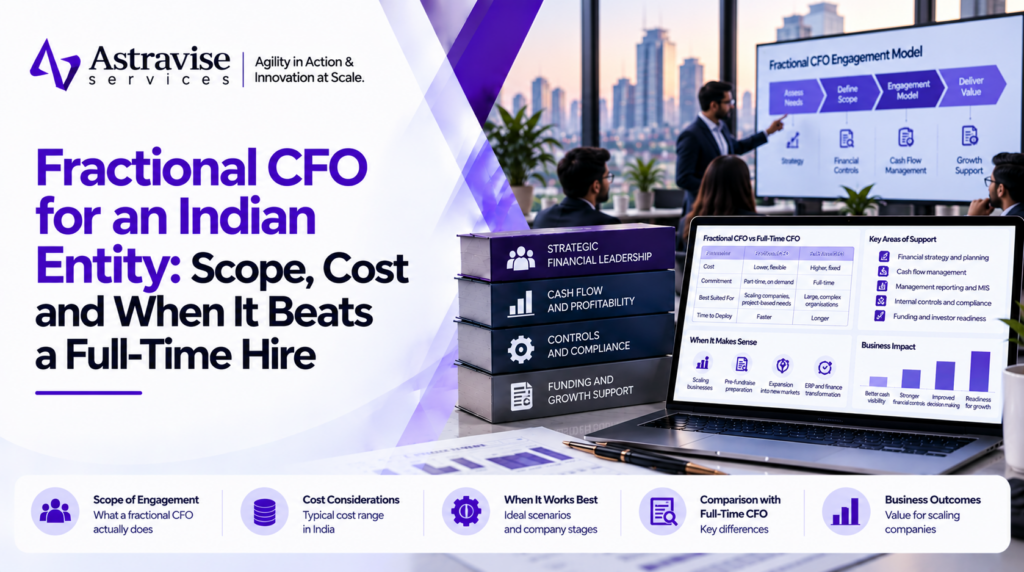
TL;DR: A fractional CFO is a senior finance leader who takes accountability for a company’s financial strategy, reporting and controls on a part-time, contracted basis. In India, “fractional”, “virtual”, “outsourced” and “part-time” CFO describe the same model, so judge the scope, not the label. The model fits a growing company, or the India subsidiary or GCC of a foreign parent, whose financial complexity has outgrown its accountant but whose scale does not yet justify a full-time CFO. It stops fitting when the company needs a statutory CFO under Section 203 of the Companies Act, 2013, or when finance decisions need a full-time owner in the room every day. There is no independently verifiable benchmark for fractional CFO fees in India, so compare the cost against a full-time hire and against the decisions currently being made without one.
Most companies engage a CFO later than they needed one. The delay rarely comes from budget. It comes from reading finance problems as accounting problems: the books are closed, the returns are filed, so finance must be fine. The gap shows up later, in a fundraise that stalls on questions nobody can answer, a board pack assembled the night before, or a foreign parent asking for numbers the India entity cannot produce in its format.
A fractional CFO fills that gap at the point where the judgement required is CFO-grade and the volume of work is not yet full-time. This guide covers what the role owns, how it works for the India entity of a foreign parent, how to think about cost, and when a full-time hire is the better answer. Astravise Services published the same analysis for people leadership in its guide to when a company should engage a strategic CHRO, and companies often reach both thresholds in the same year.
What Is a Fractional CFO, and Is It Different From a Virtual CFO?
A fractional CFO is a chief financial officer engaged part-time, on a retained contract, who carries accountability for the company’s financial decisions rather than only advising on them. The work typically covers financial planning, cash and capital, investor and board reporting, and the control environment.
In the Indian market, “fractional CFO”, “virtual CFO”, “outsourced CFO” and “part-time CFO” are used interchangeably and carry no separate meaning. None has a statutory definition. The Astravise guide to strategic CFO, virtual CFO and bookkeeping makes the same point and explains why scope, not the title, is the honest test. The model itself grew out of practising chartered accountants serving several clients at once, which the Astravise piece on moving from practising CA to virtual CFO describes from the practitioner’s side.
What does differ is the engagement, and it is worth comparing against the roles a fractional CFO is usually confused with:
| Role | Accountability | Typical engagement | Best fit |
|---|---|---|---|
| Finance controller or head of accounts | Runs the close, compliance and reporting cycle | Full-time employee | The finance architecture is settled and the job is to run it |
| CFO consultant | Delivers a defined output, such as a model, a valuation or a process review | Project, weeks to months | A bounded problem with a clear deliverable |
| Fractional CFO | Owns financial strategy, reporting to the board and investors, and the control environment | Retained, one to three days a week, six to eighteen months | Complexity has outgrown the finance team, but scale does not justify a full-time CFO |
| Interim CFO | Fills a vacant CFO seat full-time for a fixed period | Full-time, three to nine months | A departure, a transaction or a turnaround that cannot wait for a search |
| Full-time CFO | All of the above, with daily executive presence and, where required, statutory appointment | Permanent hire | Scale, listed-company governance or a statutory requirement |
The line that matters is accountability. A consultant hands over a recommendation. A fractional CFO sits in the leadership meeting, makes the call on cash, capital and controls, and answers for whether it worked.
What a Fractional CFO Does: Scope of the Engagement
Scope decides whether a fractional CFO engagement works. A fractional CFO with advisory scope and no decision rights is an expensive consultant. Write the scope down before the engagement starts, and make sure it covers these areas:
-
Diagnostic before prescription. The first three to four weeks should establish the actual state of the numbers, the controls, cash visibility and compliance, before anything is redesigned.
-
Financial planning and forecasting. An annual budget the board approves, a rolling forecast, and variance reporting that explains why the numbers moved.
-
Cash and capital. A 13-week cash view, runway, working capital discipline and the capital structure for the next raise or debt facility.
-
Board and investor reporting. A monthly MIS pack and a quarterly board pack that lead with decisions, not operating detail.
-
Controls and compliance oversight. Internal financial controls, the statutory and tax calendar, and audit readiness. The accountant files; the fractional CFO makes sure the filings are right and the controls behind them hold.
-
Transaction readiness. A data room that is kept current rather than assembled under pressure, and support through diligence.
-
Building the function that replaces them. A good fractional CFO designs their own exit from month one, including the hiring profile for the permanent finance leader.
The Astravise perspective on why disciplined capital has arrived in India puts the underlying point directly: most early-stage startups do not need a full-time CFO, they need CFO-level thinking without the full-time cost.
Fractional CFO for the India Subsidiary or GCC of a Foreign Parent
The India entity of a foreign parent is one of the clearest cases for a fractional CFO, and one of the least discussed. India hosts more than 1,700 global capability centres employing about 19 lakh professionals, according to the Economic Survey 2025-26. Many of them, and many more India sales and service subsidiaries, are too small for a full-time CFO and too exposed to run on an accountant alone.
The India entity carries obligations that do not exist at the parent, and the parent’s finance team rarely knows them:
-
FEMA reporting. Share allotments to the foreign parent are reported to the Reserve Bank of India in Form FC-GPR within 30 days, as the Astravise guide to India market entry for foreign companies sets out. A company that has received foreign direct investment also files the annual return on Foreign Liabilities and Assets with the RBI.
-
Transfer pricing. Services the India entity bills to the parent are transactions with an associated enterprise, which brings documentation, pricing and the safe harbour decision into scope every year.
-
Statutory audit and governance. Section 149(3) of the Companies Act, 2013 requires at least one director who stays in India for 182 days or more in the financial year, alongside the statutory audit and board calendar. The Astravise GCC governance blueprint lists these obligations for the first 100 days.
-
Two reporting calendars. The parent wants monthly numbers in its format and on its close timetable. Indian statutory accounts run on an April to March financial year under Indian accounting rules, which often differ from the parent’s. Someone has to reconcile the two.
A fractional CFO for an India subsidiary typically owns the reconciliation between those two worlds: parent reporting, local compliance, transfer pricing coordination with advisers, and the controls the parent’s auditors will test. For a nano or micro GCC that is still building its team, it is often the right model until the centre reaches a scale where a full-time finance head pays for itself. The Astravise guide to setting up a GCC in India covers where that finance role sits in the setup sequence.
7 Signs It Is Time to Hire a Fractional CFO
Revenue and headcount thresholds are unreliable signals. A 40-person company with foreign investors and two entities has more financial complexity than a 300-person single-entity services business. These triggers predict the need better:
-
A fundraise, acquisition or new entity is on the calendar within nine months. Diligence will test the numbers, the controls and the compliance history. Problems found late are expensive.
-
The board or investors ask for numbers nobody can produce within a week. If every request becomes a project, the company has reporting but no reporting system.
-
Nobody can state the runway to the week. Cash visibility is usually the first thing to break as a company grows, and the last thing anyone admits.
-
Consequential financial decisions are being made by people whose job is something else. When the CEO is setting pricing policy and the head of sales is negotiating payment terms, decisions are made without a consistent principle.
-
An auditor has raised control observations, or the audit is running late. Both are signs the control environment has fallen behind the business.
-
You are setting up an India entity or GCC for a foreign parent. The obligations above start from incorporation, not from scale.
-
A regulatory reset has changed the rules and nobody owns the response. The Income-tax Act, 2025 and the Income-tax Rules, 2026 took effect on 1 April 2026, which the strategic CFO guide linked above covers. Resets of that size need an owner, not a filing agent.
Three or more of these at once is the clearest signal. The decision is rarely whether to get CFO-level help. It is whether to get it before or after the problem surfaces.
Fractional CFO Cost in India: How to Think About It
There is no independently verifiable benchmark for fractional CFO fees in India. Published fee ranges trace almost entirely to firms selling the service, and Astravise Services does not publish a rate card, because a number quoted before the scope is understood is a package, not an answer. What a leadership team can do is build its own expectation from the engagement shape and from what the alternative costs.
| Engagement shape | Typical commitment | What it buys | Where it fits |
|---|---|---|---|
| Diagnostic only | Four to six weeks | An assessment of reporting, controls, cash visibility and compliance, with a prioritised plan | Leadership suspects a problem but cannot name it |
| Fractional CFO, light | One day a week, six months | Board and investor reporting, the budget cycle, compliance oversight | A single entity with no transaction on the calendar |
| Fractional CFO, full | Two to three days a week, twelve to eighteen months | Full ownership of planning, cash, capital, controls and board reporting | Multiple entities, foreign investors, or a fundraise or GCC build within the year |
| Embedded transition | Two to three days a week, tapering over twelve months | All of the above, plus hiring and onboarding the permanent finance leader | A company approaching the point where a full-time CFO pays for itself |
The alternative is a full-time CFO. Crescendo Global, an India-focused executive search firm, published compensation benchmarks in May 2026, citing Deloitte’s 2026 survey, that place median CFO compensation in India at ₹4.5 crore. Its ranges are ₹1.5 crore to ₹3 crore at a Series B or later high-growth startup, and ₹3.5 crore to ₹6 crore and above at a listed mid-cap or large enterprise. These are a search firm’s market observations, and should be read as an order of magnitude, not a quotation.
The honest comparison has three parts:
-
Total cost of a full-time hire. Fixed pay, variable pay, ESOPs, search fees and the months it takes a new CFO to become effective.
-
Cost of the fractional engagement. The retainer for the scope the company actually needs, and the time the internal team spends supporting it.
-
Cost of the gap. The price of the decisions being made today without CFO-level judgement: a down round from weak numbers, working capital locked in receivables, a compliance lapse found in diligence.
The third number is usually the largest, and it is the one most companies leave out. Cost discipline, in this sense, means deferring the full-time hire until the work justifies it, not cutting CFO-level thinking out of the business. Venkatesh Bhat’s Q4 guide for CFOs argues for planned support models over year-end firefighting.
Fractional CFO vs Full-Time CFO: When to Make the Switch
A fractional CFO beats a full-time hire while the volume of CFO-grade decisions fits into one to three days a week. The switch to full-time becomes the better answer when any of these become true:
-
The work no longer fits the days. The fractional CFO is consistently working beyond the agreed commitment, or decisions are waiting for their next day in.
-
Daily executive presence is needed. Multiple entities, a large finance team, continuous investor engagement or an active M&A programme need a CFO in the room every day.
-
The law requires one. Rule 8 of the Companies (Appointment and Remuneration of Managerial Personnel) Rules, 2014 requires every listed company, and every other public company with paid-up share capital of ₹10 crore or more, to have whole-time key managerial personnel, including a CFO. Section 203(3) prevents a whole-time KMP from holding office in more than one company except its subsidiary, so a fractional CFO cannot be that appointed CFO. The strategic CFO guide linked above covers why a virtual CFO cannot be your statutory CFO in full.
-
A listing is within two years. Pre-IPO governance, a full-time audit committee relationship and public-market reporting need a permanent CFO, and a CFO search takes longer than most boards plan for.
The best transitions are planned from the start. A fractional CFO who builds the function, defines the permanent role and helps hire into it leaves the company with a finance leader who inherits a working system rather than a clean-up job.
When a Fractional CFO Is the Wrong Answer
Three situations make the model fail, whoever provides it:
-
The need is execution capacity, not judgement. If the problem is that the books are late and the returns are wrong, hire a finance controller or fix the accounting team. A fractional CFO running the close is a misallocation.
-
The founder will not cede financial decisions. Authority granted in the contract and withheld in practice produces an adviser with a CFO title.
-
The company already needs a full-time CFO. A statutory requirement, a listing timetable or the scale of the finance function makes the fractional model a stopgap. Use an interim CFO for the gap and run the search.
How Astravise Services Structures a Fractional CFO Engagement
Astravise Services starts every CFO engagement with an independent diagnostic rather than a predefined package. Governance is not a side hustle, and the diagnostic is where the gap between what leadership believes about the numbers and what the data shows usually appears.
From there, the engagement runs in four stages:
-
Diagnose. Establish the state of reporting, controls, cash visibility, compliance and, for an India subsidiary, the parent reporting and transfer pricing position.
-
Stabilise. Close the compliance and control gaps that carry immediate risk, and put a monthly reporting rhythm in place.
-
Build. Establish the budget and forecasting cycle, the board pack, the capital plan and the control environment the next audit or diligence will test.
-
Transition. Define the permanent finance role, help hire into it, and hand over a working system.
For India subsidiaries and GCCs, the work connects with Astravise GCC Advisory and Management so that finance, governance and setup run on one plan. Companies weighing a fractional CFO against a full-time hire can start with a diagnostic through Astravise Strategic CFO advisory.
Frequently asked questions
- What is a fractional CFO?
- A fractional CFO is a chief financial officer who works with a company part-time, usually one to three days a week on a retained contract, and carries accountability for financial strategy, cash and capital, board and investor reporting, and the control environment. The model exists because a growing company often needs CFO-grade judgement before the volume of work justifies a full-time CFO. It differs from a CFO consultant, who delivers a defined project and leaves, and from an interim CFO, who fills a vacant seat full-time for a fixed period.
- What is the difference between a fractional CFO and a virtual CFO in India?
- In practice, none. “Fractional CFO”, “virtual CFO”, “outsourced CFO” and “part-time CFO” are used interchangeably by most Indian providers and have no statutory definition. The meaningful differences are in the engagement itself: how many days a week, what decisions the CFO owns, whether the scope covers strategy or only operations, and whether the engagement includes building the permanent finance function. Judge any offer by its written scope rather than its label.
- How much does a fractional CFO cost in India?
- There is no independently verifiable benchmark. Published fee ranges trace almost entirely to firms selling the service. A better approach is to compare three numbers: the full cost of a full-time CFO, the retainer for the scope you actually need, and the cost of the financial decisions currently being made without CFO-level judgement. As a reference point for the first, executive search firm Crescendo Global, citing Deloitte’s 2026 survey, puts median full-time CFO compensation in India at ₹4.5 crore, with ₹1.5 crore to ₹3 crore typical at Series B and later startups.
- Can a fractional CFO be the statutory CFO of our India company?
- Not if your company is required to appoint one. Rule 8 of the Companies (Appointment and Remuneration of Managerial Personnel) Rules, 2014 requires a whole-time CFO in every listed company and in every other public company with paid-up capital of ₹10 crore or more. Section 203(3) of the Companies Act, 2013 prevents a whole-time key managerial person from holding office in more than one company except its subsidiary. An unlisted private company below those thresholds has no statutory CFO requirement, so a fractional CFO can lead its finance function.
- Does the India subsidiary of a foreign company need a CFO?
- Not by statute, unless it is a listed or qualifying public company. But it carries obligations the parent’s finance team rarely knows: FC-GPR reporting of share allotments within 30 days, the annual Foreign Liabilities and Assets return to the RBI, transfer pricing on services billed to the parent, a resident director under Section 149(3), and reconciling Indian statutory reporting with the parent’s monthly close. A fractional CFO is often the right model until the entity is large enough for a full-time finance head.
- When should a company move from a fractional CFO to a full-time CFO?
- When the CFO-grade work no longer fits into one to three days a week, when the business needs a finance leader present every day, when a listing is within two years, or when the company becomes subject to Rule 8 and needs a statutory whole-time CFO. The best transitions are planned: the fractional CFO builds the finance function, defines the permanent role and helps hire into it, so the new CFO inherits a working system rather than a clean-up.