
As 2025 marches toward its final quarter, CFOs at startups and MSMEs face a familiar—and yet unfamiliar—challenge: closing the year with discipline while keeping one eye on the growth horizon. The pace of business has shifted. Forecasts move faster, expectations are higher, and stagnation feels like failure.
To understand what CFOs are walking into now, it helps to look at what’s shaped the year so far.
Trends That Set the Stage for Q4
- Digital on the Rise, But Gaps Remain
Nearly 80% of CFOs say leading digital transformation is a top priority in 2025, with AI and finance tech strategy ranking among the critical drivers of change. Yet, only a fraction report meaningful results, exposing a gap between ambition and execution. - Growth Above Anything Else
In APAC, finance leaders increasingly rank enterprise growth ahead of traditional financial mandates – highlighting the expanded role of the CFO beyond cost control into direction-setting - Smarter Spending, Not Less
Post-global shocks, many CFOs have resumed cost-cutting but now, with a smarter agenda. Optimizing costs to drive growth is top of mind; macro risks like inflation and geopolitical instability such as tariff uncertainty add urgency. - Digitalisation Gains Traction in MENA
Roughly 78% of finance leaders in the wider Asia-MENA corridor say extracting meaningful insights from data is driving digital finance investments. While India leads with ERP and analytics adoption, MENA markets are similarly prioritising digital tools for financial control and efficiency.
What to Expect in Q4
From this backdrop, Q4 2025 will likely see CFOs juggling 3 imperatives:
- Tightened Forecast Discipline
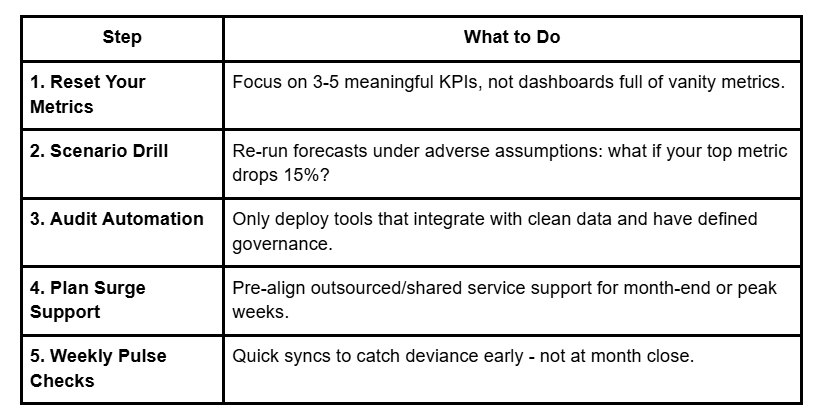
With macro volatility becoming the norm, CFOs can no longer close the books once and rest. Regular scenario scans for navigating rate shocks, demand shifts, and margin crunches will be essential. - Tech, Not Talk
CFOs who survive Q4 successfully will be those who deploy automation and AI tools – forecasting models, dashboards, smart pipelines – but only when structured governance and reliable data are in place. - No More Firefights
Stretching resources and talent thin during year-end crunches only increases turnover and error. CFOs must shift to planned support models (e.g., shared services, surge help, GCC bandwidth) rather than rely on reactive firefighting.
A Sample Q4 Dashboard
Here’s what a lean, Q4-ready dashboard might track:
- Cash Runway & Burn Rate: Weeks of runway and temporary savings from automation.
- Forecast Variance: Running trailing scenarios (best case / base / bad case).
- Strategic Spend Adherence: Capex vs opex, hiring velocity vs budget.
- Surge Readiness: Backup support capacity in the form of shared services, GCC, interim finance teams.
How CFOs Can Steer Q4 Effectively
How ASPL Supports CFOs
At ASPL, we’ve built systems and models that can empower CFOs to finish the year with both control and optimism. Here’s how:
- Governed Shared Finance Services
We help build finance ‘control towers’ – virtual CFO frameworks or GCC setups so CFOs don’t scramble during peaks. - Forecast Models & Scenario Frameworks
Custom dashboards that enable frequent scenario reviews and highlight early warning signals, not just monthly summaries. - Q4 Surge Playbooks
Ready-to-deploy interim capacity models and process blueprints that ensure financial close remains smooth and resilient.
Q4 is about building resilience while staying on the growth path. The CFO who tightens controls without throttling momentum is not only surviving the season – they’re setting the stage for a stronger 2026.
ASPL stands ready as a partner, helping finance leaders systematize forecasting, shore up closing processes, and ensure Q4 is less scramble, more strategy.