
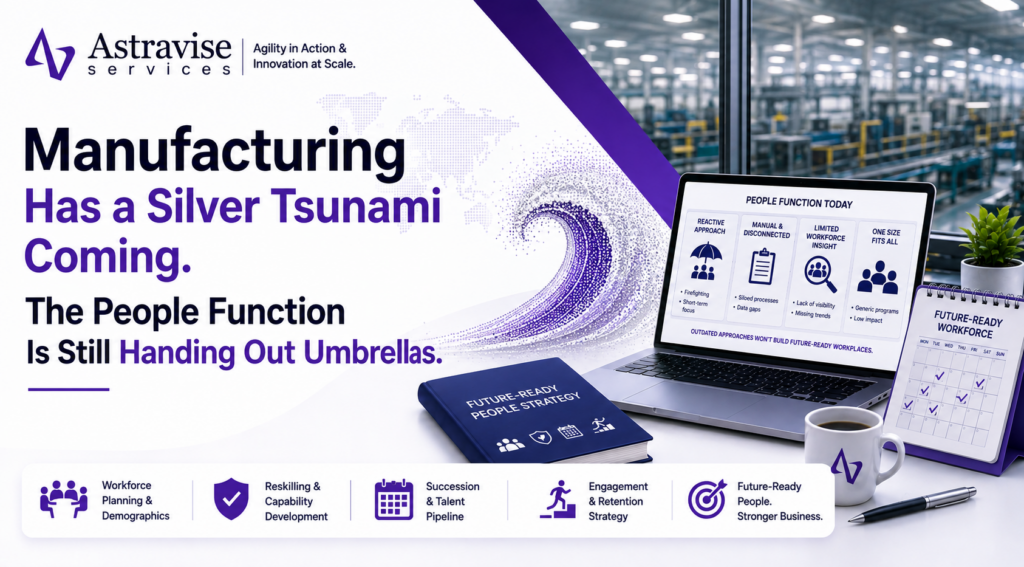
A first-person perspective on why India’s MSME manufacturing and engineering sector is about to lose its valuable asset – and why the people function needs a different mandate before the wave hits.
I have visited enough manufacturing plants across India to know that the most important conversation rarely happens in the boardroom. It happens on the shopfloor, usually somewhere between the second and third machine bay, with someone who has been running that line for longer than most of the management team has been employed.
On one such visit, I found myself standing next to a senior process engineer – twenty eight years with the same organisation, the kind of person who could tell you not just how the line ran but why a specific tolerance had been set the way it was in 1999, which vendor had caused a three week production delay in 2011, and which workaround somebody invented during a breakdown that quietly became standard operating procedure for the next decade. He was six months from retirement. His replacement had joined four weeks earlier. The replacement was enthusiastic, well qualified, and had absolutely no idea what he did not know yet – which is the most dangerous place to be on a manufacturing floor.
When I asked how the handover was going, he smiled the way people smile when the honest answer would take longer than the conversation allows.
“I am showing him what to do,” he said. “Nobody has time for me to show him why.”
The silver tsunami is the name the industry has given to what is already underway – a generation of experienced engineers, process leads, and shopfloor supervisors retiring in waves, taking decades of hard-won knowledge with them. Nearly one third of the manufacturing workforce globally is over 55.[1] Deloitte and The Manufacturing Institute project a net need for 3.8 million manufacturing jobs between 2024 and 2033, with nearly half at risk of going unfilled.[2]
For a large enterprise with a dedicated HR function, a succession planning team, and a learning and development budget, this is a serious problem. For an MSME manufacturing unit – where the owner is often also the operations head, the HR function is whoever has time, and the succession plan is an optimistic assumption – it is an existential one.
The drawings stay behind. The equipment stays behind. The standard operating procedures stay behind. What walks out of the gate on the last Friday of every retiring engineer’s career is the reasoning behind all of it – the judgment calls, the institutional memory, the thirty years of knowing which shortcut works and which one caused the fire of 2007 that nobody put in the report. That last one, incidentally, is always the most useful thing to know – and the first thing that disappears.
That knowledge does not live in any system. It lives in people. And once it is gone, rebuilding it can take years – if it gets rebuilt at all.[3]
Here is where the people function comes in – or rather, where it has not been coming in, which is the actual problem.
In many MSME manufacturing organisations, HR is still largely structured around what it was built to do twenty years ago. Recruitment when a position opens. Payroll. Compliance. The annual appraisal cycle that everyone fills out and nobody reads. In some plants I have visited, the last completed appraisal form on record predates the machine it was written about. It is the organisational equivalent of a first aid kit – useful when something has already gone wrong, completely silent on preventing the thing from going wrong in the first place.
Nobody formally owns the question of what happens when the engineer who knows why the tolerance was set that way in 1999 submits his resignation. Nobody has built a framework for capturing what he knows before he clears his desk. Nobody has mapped which roles in the organisation are single points of failure – where one retirement does not just create a vacancy but removes an entire category of institutional memory that nobody else holds.
This is not a recruitment problem. Filling the seat is the easy part, relatively speaking. The hard part – the part that compounds quietly and expensively across every wave of retirements – is that the new person in the seat inherits the title and the desk but not the decades of judgment that made the previous occupant irreplaceable.
A single senior engineer often holds the institutional memory for an entire product line. When several of those people leave inside the same eighteen-month window, the loss does not add – it multiplies.[3]
The organisations navigating this well are not doing something complicated. They are doing something that requires the people function to have a mandate it is rarely given in MSME manufacturing – to think ahead of the vacancy, not in response to it.
Structured knowledge transfer built into the last twelve months of a senior employee’s tenure, not the last four weeks. Workforce mapping that identifies where institutional knowledge is concentrated and where the organisation is most exposed. Succession frameworks that treat the shopfloor and operations leadership with the same seriousness that boardrooms reserve for the top floor.
None of this is complicated in concept. It is complicated in execution when the people function does not have the mandate, the seniority, or the organisational standing to drive it – and when the owner is still the de facto HR head between two other jobs.
The silver tsunami is not coming. It is already here, arriving shift by shift, retirement by retirement, in plants across the country where the person who knew why still had a desk last month and does not have one anymore.
The umbrella is not going to be enough.
Part 2 examines the second challenge compounding this crisis – why manufacturing locations struggle to attract the next generation of talent, and what the people function needs to do differently before the pipeline runs dry.
Astravise Services works with MSME manufacturing and engineering organisations through Strategic CHRO Advisory – helping leadership build the people infrastructure, knowledge transfer frameworks, and workforce design that ensures what walks out the gate on a Friday does not take the organisation’s institutional memory with it.
📩 info@astraviseserv.com | astraviseservices.com
This article is intended for informational purposes and reflects the analytical perspective of Astravise Services. Statistical data cited is drawn from publicly available third-party research.
References
[1] Engineering Retirement Knowledge Loss 2026 | getleo.ai
[2] Deloitte & The Manufacturing Institute – Manufacturing Workforce Outlook 2024–2033 | deloitte.com
[3] Manufacturers Risk Losing Critical Knowledge as Workforce Retires | assemblymag.com