
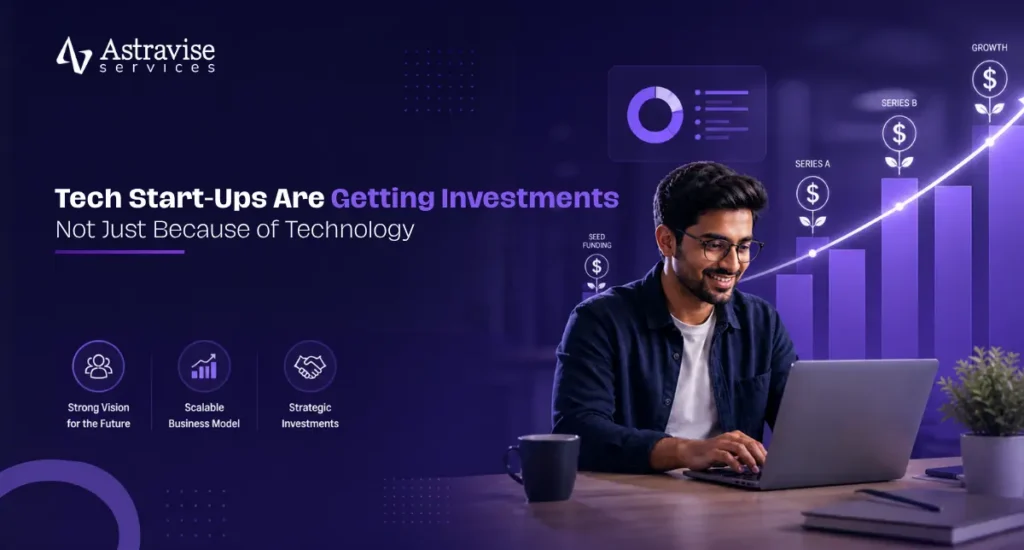
What is driving investment decisions in India’s startup ecosystem in 2025 — and what that means for every founder still building the case.
1. Something Shifted and Founders Who Missed It Are Still Wondering Why
There was a period, not that long ago, when a genuinely differentiated technology was enough to get serious investor attention. Build something that nobody else had built, demonstrate that it worked, and the conversation about funding followed naturally. The technology was the story.
That window has not closed entirely, but it has narrowed considerably. India’s startup ecosystem crossed 31,000 to 34,000 funded tech startups in 2025 which means the baseline of what counts as technically capable has risen significantly. Walking into an investor meeting with solid engineering and a working demo is table stakes now, not a differentiator. Investors have seen enough technically impressive products that did not become businesses to know that the two things are not the same.
What changed is where the weight of the investment decision now sits and it has moved decisively beyond the product.
Source: NASSCOM-Zinnov Indian Tech Startup Report 2025 | nasscom.in
2. Where the Money Is Going and Where It Is Stopping
India’s total tech startup funding hit USD 9.1 billion in 2025, up 23% from the year before. The headline looks healthy. The distribution beneath it tells a more specific story.
74% of all deals were at seed and early stage. Late-stage capital the kind that validates a business at scale stayed highly concentrated, flowing into companies that had already demonstrated something beyond a working product. 85% of seed-stage ventures do not advance to Series A within five years, and the NASSCOM-Zinnov report is direct about why: the progression barrier is structural, not technological. Securing early customers consistently outranks building products or teams as the defining constraint on whether a startup moves forward.
Startups with monthly recurring revenue growing above 15% were twice as likely to close Series A rounds in 2025. Founders who adapted their commercial model based on market feedback raised 30% more capital on average. The investors were not chasing the sharpest technology they were chasing the clearest evidence that a business was forming around it.
Source: NASSCOM-Zinnov Indian Tech Startup Report 2025 | Founder Institute Startup Funding Benchmarks 2025 | fi.co
Technology gets a founder into the room. What happens in that room is decided by everything built around it.
3. Three Things Investors Are Stress-Testing That Have Nothing to Do with the Product
When a Series A investor evaluates a startup, the product has already passed their threshold otherwise the meeting would not be happening. What they are working through in that conversation is a different set of questions entirely.
The first is financial discipline. Does the founder understand their unit economics well enough to explain where the business makes and loses money at each stage of growth? Is there a capital allocation framework, or is spending reactive? Has the finance function been built to give investors’ confidence in the numbers, or is it still running on a spreadsheet that one person maintains? These are CFO-level questions, and startups that cannot answer them clearly tend to find that investors move on to ones that can.
The second is whether the team infrastructure can support the scale the founder is promising. A team of twelve that functions well because everyone knows each other is a different organisation from a team of eighty where accountability, hiring decisions, and performance expectations need to be structurally embedded. Investors have watched too many Series A hires destabilise organisations that were not designed to absorb them the people governance question is now part of the investment thesis evaluation.
The third is commercial credibility. Is there a go-to-market framework that has been tested against paying customers, or is the revenue story still largely projection? M&A activity in India’s tech ecosystem doubled from 72 to 144 deals between 2024 and 2025 and the companies being acquired were not the ones with the strongest technology. They were the ones with the most defensible commercial and operational foundations.
Source: NASSCOM-Zinnov Indian Tech Startup Report 2025 | nasscom.in
4. What the Founders Who Are Getting Funded Did Differently
The founders navigating this well are not necessarily the ones who built the most impressive products. They are the ones who treated financial governance, people infrastructure, and commercial strategy as part of the core build not as things to sort out after the next round closes.
That means financial leadership capable of structuring capital decisions and building the controls that give investors’ confidence in the numbers. It means people governance that can support a team doubling in size without the cultural and operational friction that slows execution. And it means a commercial strategy grounded in enough customer evidence that an investor can underwrite it with confidence rather than hope.
At Astravise Services, this is the work we do alongside leadership teams of growing enterprises helping build the financial, people, and operational infrastructure that gives a scaling business the foundation to match its ambition. The technology was always necessary. What surrounds it is what determines whether it goes anywhere.
If the gap between your product and your business infrastructure is a conversation worth having, we would welcome it.
Contact us at: info@astraviseserv.com | astraviseservices.com