

A first-person perspective on why India’s IT companies are scaling faster than their financial infrastructure – and what a Strategic CFO changes about that.
1. The Spreadsheet That Holds Everything Together – Including Your Blood Pressure
It was a Tuesday morning in Bengaluru, the kind where the air conditioning in the office was doing its very best impression of a ceiling fan in summer – technically functional, thoroughly unconvincing. I had come in to meet the finance lead of a 400-person IT services company that had been growing at 30% year on year for four consecutive years. The sales team was closing contracts across three geographies, delivery teams were running parallel projects across time zones, and the founder was fielding calls from investors asking pointed questions about unit economics.
The finance lead was one person. She had not taken a holiday in three years. When I asked to see the financial model, she pulled up an Excel file with seventeen tabs, a password she had to remember twice because she had changed it recently, and a colour-coding system she described, with complete sincerity, as self-explanatory. It was not self-explanatory. It was, however, the only thing standing between the business and complete financial blindness – and she knew it, which is probably why she had not taken that holiday.
This is not a story about poor management. It is a story about a business that grew at 30% a year while its finance infrastructure grew at approximately zero. Revenue was climbing, clients were happy, and nobody stopped to ask whether the plumbing underneath could handle the pressure. Over 65% of CFOs in India cite regulatory compliance as a significant challenge [1] – and in IT specifically, that number understates the problem, because compliance is only one layer of a far more complicated stack.
2. Why IT Finance Is Not Like Any Other Industry’s Finance
I use a comparison in client conversations that tends to land well. A manufacturing company’s finance function is like a straight road – goods go out, invoices come in, cash follows, everyone goes home. An IT services company’s finance function is like a roundabout with six exits, none of them clearly labelled, a new exit appearing every time you sign a different kind of contract, and the occasional lorry entering from the wrong direction because someone forgot to tell the client about the billing cycle.
A fixed-price project bleeds margin for two months before the project manager mentions it – and when he does mention it, it is in a status update buried between slide fourteen and the AOB section of a deck nobody read. A multi-year managed services contract has a revenue profile and a cost profile that follow completely different curves. A SaaS product sits under Ind AS 115[4] and requires accounting judgment that a team hired to process transactions was genuinely never trained to apply. And somewhere in the background, the company is billing in USD and GBP while paying salaries in INR, which means every rate movement is quietly reshaping the margin without anyone formally owning that risk. Over 60% of India’s CFOs are now prioritising AI and data analytics integration [2] – and the IT finance function sits at the centre of all of it, trying to make sense of data across entities, geographies, and contract types simultaneously, usually with a team that was sized for a business half this size.
Revenue growth in an IT company is like a high tide – it lifts everything, including the gaps in the hull. The gaps only become visible when the tide goes out, which is usually exactly when you cannot afford to be bailing water.
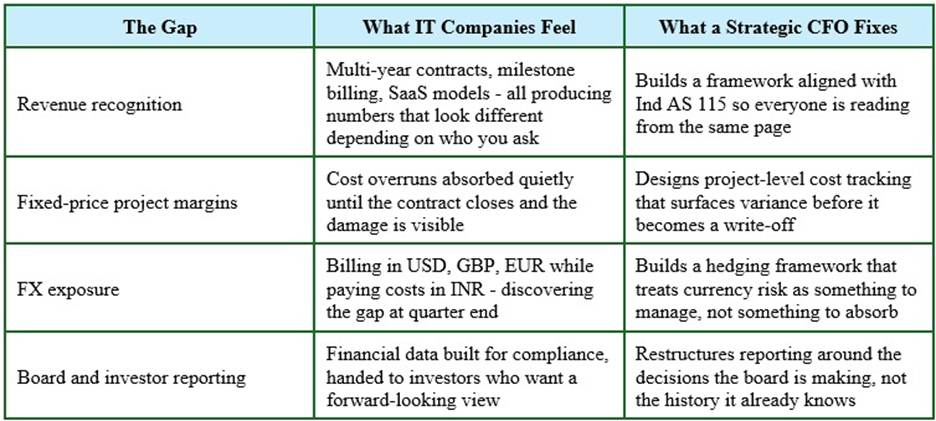
3. The Four Places the Gap Shows Up – and What Changes
4. The Moment Every IT Founder Has – Usually at the Worst Possible Time
I have sat in enough of these rooms to recognise the look. It is a specific expression that crosses a founder’s face when, mid-conversation with a Series B investor, they are asked for a revenue waterfall by contract type – and they realise, with a clarity that arrives about three seconds too late, that no such report exists. What follows is a three-week scramble to build something that should have been a standard dashboard, happening at the exact moment the finance team’s bandwidth is least available and the investor’s patience is least infinite.
Or it happens during a large client contract renewal, when the enterprise client requests a project financial audit and the data required is sitting across three systems that were integrated in the way all temporary integrations are – which is to say, not really. Or when a founder explores an acquisition and the due diligence reveals that the target’s revenue recognition policy has been applied inconsistently for two years, which the target’s own finance team had not flagged because nobody had asked them to look. The Deloitte Global Outsourcing Survey 2024 found that 54% of finance organisations are expanding their capacity for higher-value work by rethinking how the function is structured [3]. For India’s IT sector, that rethinking is overdue – and it is almost always prompted by one of the moments above.
5. What a Strategic CFO Changes – and Why the Timing Matters
The Strategic CFO advisory work we do at Astravise Services with IT and technology companies starts from one observation: the finance function needs to be built for the decisions the leadership team is making, not the transactions the accounting team is recording. In an IT business, those two things can be very far apart – and the distance between them is where margin leaks and risk accumulate without anyone formally owning it.
Building a revenue recognition framework that gives leadership a clean contract-by-contract view. Designing project-level cost tracking that surfaces variance before the contract closes rather than after. Creating a treasury policy that treats FX exposure as a financial risk to be managed rather than a quarterly surprise to be absorbed. Restructuring the reporting cadence so the board is making decisions on forward-looking data rather than reading last quarter’s history in a deck that took two weeks to produce.
None of these are complicated ideas. They are the kind of work that requires someone in the finance function to have both the mandate and the seniority to do it – which is precisely what a Strategic CFO brings, and precisely what a team of two accountants and a compliance vendor cannot.
India’s IT sector is producing businesses of genuine scale and genuine complexity. The financial infrastructure underneath them either compounds that into value or lets it accumulate into risk. In my experience, that choice is made earlier than people think – and it is made by who is sitting in the finance leadership seat, not by what the revenue chart looks like.
Is your IT company’s finance function built for the stage the business is operating at – or the one it was at two years ago?
Astravise Services’ Strategic CFO advisory helps IT and technology companies build the financial infrastructure that matches their ambition – before the investor meeting, the client audit, or the acquisition forces the rebuild.
📩 info@astraviseserv.com | astraviseservices.com
References
[1] Deloitte Asia-Pacific CFO Survey 2025 | Finsmart Accounting CFO Challenges Report 2024
[2] PwC CFO Pulse Survey 2025 | Deloitte Asia-Pacific CFO Survey 2025
[3] Deloitte Global Outsourcing Survey 2024 | Gartner CFO Priorities Report 2025
[4] Ind AS 115 – Revenue from Contracts with Customers | RBI Hedging Guidelines 2024