
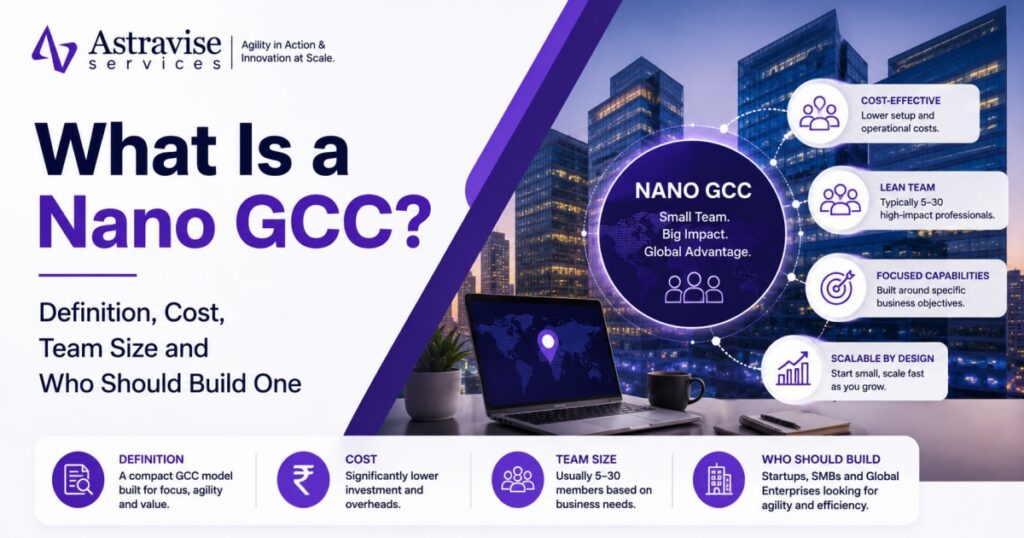
TL;DR: A nano GCC is a small, wholly-owned capability centre, typically a handful to a few dozen specialists, built to own a specific high-value capability rather than to run volume operations. The one official definition that exists, in Karnataka’s GCC Policy 2024-2029, pegs it at 5 to 50 employees. Most of the market quotes a range twice that size, which tells you the term is being stretched to fit whatever a vendor is selling. A nano GCC is the right answer for a mid-market or PE-backed company that needs a specific capability it cannot buy off a vendor’s shelf, and the wrong answer for a company that actually needs scale and is using “nano” to avoid admitting the cost of it.
What Is a Nano GCC?
Strip away the marketing and a nano GCC is three things at once: small, wholly owned, and capability-first.
Small, because the whole point is a lean team rather than a campus. Wholly owned, because a nano GCC is a captive, the parent owns the entity, the people and the intellectual property, which is what separates it from outsourcing. And capability-first, because the mandate is to own a specific domain, AI, data, cybersecurity, product engineering, specialised R&D, rather than to process transactions at volume.
The category is new enough that nobody agrees on the number. Published definitions in 2026 range from 10 to 30 people, to 5 to 100, to 20 to 200. That spread is not a detail. It is the tell. When a term’s definition varies by a factor of ten, the term is being defined by whoever is selling against it rather than by anything fixed.
There is exactly one authoritative anchor. Karnataka’s GCC Policy 2024-2029, the first dedicated state GCC policy in India, formally codified the category, and the primary references to it, including India Briefing and Cushman & Wakefield, put the nano GCC at 5 to 50 employees, receiving incentives without any minimum employment or investment threshold. That is the number to use, because it is the only one attached to a government document rather than a sales deck.
A note on the neighbours in the taxonomy, because they get used loosely. Micro GCC is sometimes used interchangeably with nano and sometimes for the tier just above it. Mid-market GCC usually means 50 to 300 people. The labels matter less than the principle: the smaller the team, the more it must justify its existence through the value of the capability it owns, not the volume of work it does. A 20-person team cannot win on economies of scale. It has to win on being the only team that owns a particular thing.
Why Nano GCCs Exist Now: The Three Things That Changed
For two decades, the Indian GCC story was a scale story. Bigger campuses, more headcount, larger cost savings. The nano GCC is a departure from that, and three specific things made it possible.
AI compressed what a small team can deliver. The work that once needed forty people can, in several domains, now be done by fifteen with the right tooling. That is not a slogan, it is the mechanism: the gap in output between a 20-person team and a 200-person team is narrower than it has ever been, which makes a small, senior, well-equipped team a viable unit of capability rather than a pilot that must grow or die.
Business cycles compressed the time available. Mid-market and growth-stage companies do not have twelve months to stand up a delivery hub. They need a specific set of people, aligned to where the business is going, running in weeks. A nano GCC is designed for that timeline in a way a traditional 200-seat build is not.
Policy removed the floor. This is the underrated one. Karnataka’s GCC Policy 2024-2029 was the first in India to extend incentives to nano GCCs without minimum employment or investment thresholds, which matters because every earlier incentive framework implicitly assumed you were building at scale. The policy sits inside a genuinely ambitious state vision, to attract 500 new GCCs and reach 1,000 in Karnataka by 2029, generating USD 50 billion in economic output, and other states have since followed with their own frameworks. When the government stops rewarding only the big builds, small builds become economically sensible for the first time.
We wrote about this shift against Karnataka’s budget vision in the next phase of GCC growth, and about where the talent is actually moving in the Tier-2 takeover of 2026.
Nano GCC Team Size: What the Numbers Actually Mean
The 5-to-50 range is a policy boundary, not a design recommendation. Inside it, team size should follow the mandate, not the other way round, and in practice successful nano GCCs cluster at the smaller end and grow deliberately.
The composition matters more than the count. A nano GCC is senior-weighted by design. It has no room for a large base of junior staff learning on the job, because there is no volume of routine work for them to learn on and no bench to absorb their ramp time. A 20-person nano GCC is closer to 20 senior individual contributors and leads than to a pyramid, which has three consequences the headcount number hides:
-
The salary line is higher per head than a traditional GCC of the same size, because you are buying seniority, not seats.
-
Every departure hurts more. A 25% attrition rate that a 500-person centre absorbs is an existential event for a 25-person team; losing six of your twenty-five people in a year is a threat to project continuity, not a statistic.
-
There is no functional slack. A small team cannot offer the broad service range a mature GCC provides, so the mandate has to be narrow enough that the team can actually own it.
This is why the honest sizing question is not “how few people can we get away with.” It is “what is the smallest team that can genuinely own this capability, including cover for the people who will leave.” Model attrition into the headcount from day one. A nano GCC sized with no replacement provision is a nano GCC sized to fail in month eighteen.
Nano GCC Cost: How to Think About It Without Being Sold a Number
You will find setup figures for nano GCCs starting anywhere from USD 500,000. Treat every one of them the way you would treat any GCC cost quote: as a sales input that omits the four variables that actually determine cost. We set out the full method in the GCC cost benchmark, and it applies here with two adjustments specific to small teams.
Adjustment one: fixed costs do not shrink as fast as headcount. Entity setup, compliance, a resident director, statutory registrations, a governance structure and an office all have a floor that does not scale down to twenty people. The per-head cost of a nano GCC is therefore higher than the per-head cost of a large one, which is the opposite of the economy-of-scale story, and it is the single most important thing to understand before you build one. A nano GCC is not a cheap GCC. It is a small GCC, and small carries a per-head premium.
Adjustment two: the incentives are disproportionately valuable at this size. Because Karnataka extends benefits to nano GCCs without a headcount floor, a small team can access rental reimbursement, EPF contribution reimbursement of up to ₹3,000 per employee per month for two years in the Beyond Bengaluru clusters, and capital-expenditure funding of up to 75% for innovation labs outside Bengaluru. On a twenty-person team, an EPF reimbursement of ₹3,000 per head is a material fraction of statutory cost, in a way it never would be as a percentage line on a 500-person budget. The incentive that is a rounding error for a large GCC is a real lever for a nano one. But note the fine print: several of the richest incentives, recruitment and rental assistance in particular, carry a minimum of 100 employees in the Beyond Bengaluru tier, which a nano GCC by definition does not meet. Read the eligibility, not the headline.
The people cost still dominates, as it does in any services GCC. Fully load it, gross salary plus roughly 12% to 15% statutory on-cost plus benefits plus a real attrition provision, and remember that the senior-weighted mix pushes the average higher than a general salary survey implies.
Who Should Build a Nano GCC, and Who Should Not
This is the part that matters, because the model is genuinely right for some companies and genuinely wrong for others, and the marketing does not distinguish.
Build a nano GCC if:
-
You are a mid-market, growth-stage or PE-backed company that needs a specific capability, and the capability is core enough that you do not want it sitting inside a vendor you do not control.
-
The mandate is narrow and deep: own the AI platform, own the data infrastructure, own a specialised R&D problem. Something a small senior team can fully own.
-
You want IP ownership and control from day one, which a captive gives you and outsourcing does not.
-
You can commit to the capability, not just experiment with it. The sustainable nano GCCs are the ones with a real mandate; the ones set up as tentative pilots are the ones that dissolve inside two years.
Do not build a nano GCC if:
-
What you actually need is scale, and “nano” is a way of avoiding the conversation about what scale costs. If the honest headcount is 150, calling it nano does not make it cheaper, it makes it under-resourced.
-
The work is genuinely transactional and volume-driven. That is what a traditional GCC or an outsourcing arrangement is for, and forcing it into a small captive removes the one advantage a nano GCC has.
-
You cannot absorb the attrition risk. If losing three people would end the project, the team is too small for the mandate, and you should either narrow the mandate or size up.
-
You are treating it as a cheap experiment. The fixed costs of a captive, entity, compliance, governance, do not reward a half-committed pilot. If you want to test the water, an employer-of-record or managed-team bridge is the honest instrument, with a stated end date, not a captive you may abandon.
The through-line is simple. A nano GCC earns its keep when the value of owning a specific capability exceeds the per-head premium of building small. When it does not, you are paying captive prices for a team too small to justify them, and one of the larger operating models, or a vendor, is the better answer. That decision is exactly what the GCC Compass is built to test.
Frequently asked questions
- What is a nano GCC?
- A nano GCC is a small, wholly-owned capability centre built to own a specific high-value domain, such as AI, data, cybersecurity or specialised R&D, rather than to run volume operations. It is a captive, so the parent owns the entity, the people and the intellectual property. The only official definition, in Karnataka’s GCC Policy 2024-2029, sets it at 5 to 50 employees. Definitions elsewhere vary widely, which reflects how new and loosely used the term is.
- How many people are in a nano GCC?
- Between 5 and 50, per the one government definition that exists. In practice successful nano GCCs cluster at the smaller end and are senior-weighted, closer to a group of senior specialists and leads than to a pyramid with a junior base. Because there is no bench, team size should follow the mandate and must include a realistic provision for attrition, since a single departure has a much larger impact on a 20-person team than on a 500-person one.
- How much does a nano GCC cost to set up?
- Published figures start around USD 500,000, but any single number omits the variables that actually drive cost: headcount and seniority, city, function and entry model. Two things are specific to nano scale. Fixed costs, entity, compliance, governance, office, do not shrink in proportion to headcount, so the per-head cost is higher than for a large GCC. And state incentives, being available to nano GCCs without a headcount floor in Karnataka, are disproportionately valuable at small scale. A nano GCC is a small GCC, not a cheap one.
- What is the difference between a nano GCC and a micro GCC?
- The terms are used inconsistently. “Micro GCC” is sometimes a synonym for nano and sometimes labels the tier just above it. Neither has a settled numeric definition outside Karnataka’s 5-to-50 nano boundary. The useful distinction is not the label but the principle: the smaller the team, the more it must justify itself through the value of the capability it owns rather than the volume of work it processes.
- Is a nano GCC better than outsourcing?
- It depends on control and IP. A nano GCC is a captive, giving the parent full ownership of the team, the work and the intellectual property from day one, which outsourcing does not. That makes it the better choice when the capability is core and you do not want it inside a vendor you do not control. Outsourcing remains the better choice for genuinely transactional, volume-driven work where control matters less than flexibility. The wrong reason to choose a nano GCC is cost alone.
- Which company should build a nano GCC?
- A mid-market, growth-stage or PE-backed company that needs a specific, core capability it wants to own rather than rent, with a mandate narrow and deep enough for a small senior team to fully own, and the commitment to treat it as a real capability rather than an experiment. Companies that actually need scale, that have genuinely transactional work, or that cannot absorb the attrition risk of a small team, should look at a larger operating model or a vendor instead.
What This Really Comes Down To
The nano GCC is a real and useful development, and it is also a term doing a lot of marketing work. Both things are true. The model genuinely lowers the entry barrier for companies that were previously told they were too small to have a captive, and the policy environment genuinely rewards it now in a way it did not two years ago. That is worth taking seriously.
But governance is not a side hustle, and it does not get cheaper because the team is small. A twenty-person captive still needs an entity, a board, a compliance calendar and a real owner for its capability, and the companies that treat “nano” as permission to skip that are the ones whose centres dissolve inside two years. Small does not mean informal.
Great execution is thinking at the macro level and executing at the micro level. The decision to own a specific capability in India is the macro. The right five roles, the attrition cover, the incentive eligibility read correctly rather than off the headline, the entity built properly for twenty people rather than improvised: that is the micro. Both, or neither.
Astravise Services designs nano and micro GCCs the same way we design the large ones, capability first and headcount second, because a small team built around a clear mandate outperforms a larger one built around a vague one. Our GCC Advisory works alongside Strategic CFO and Strategic CHRO capability, because even a twenty-person centre sits at the intersection of finance, people and governance. Talk to us about whether a nano GCC is the right instrument for your mandate, or whether it isn’t.