
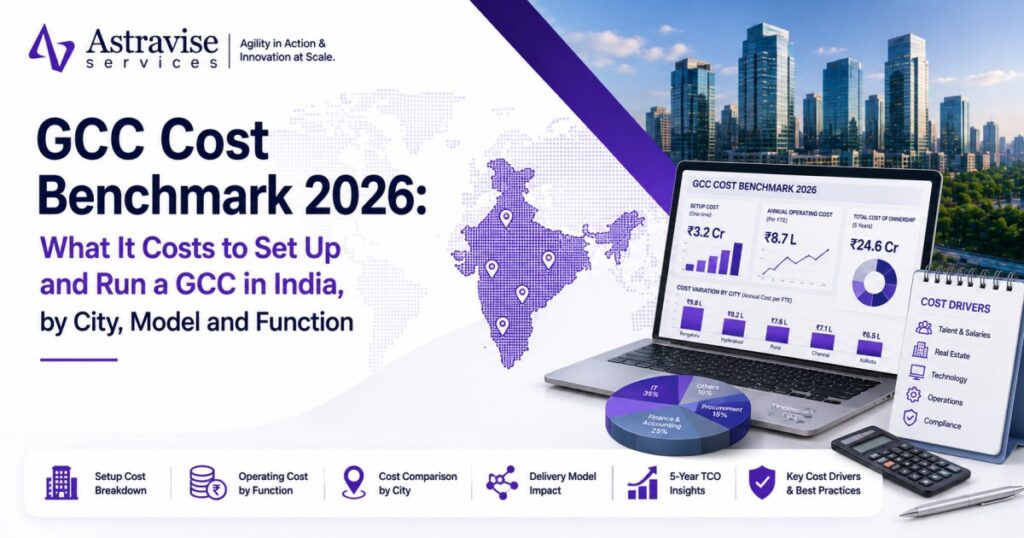
TL;DR: There is no single honest number for what a GCC in India costs, and anyone who quotes you one without four inputs, city, model, function mix and headcount, is quoting a sales figure. What can be stated with confidence in 2026: fully-loaded employer cost runs roughly 12% to 15% above gross salary before benefits, all seven Tier-1 cities now sit in a rent band between about ₹74 and ₹125 per sq ft per month, Mumbai, Bengaluru and NCR all crossed ₹100 for the first time in Q1 2026, and Tier-2 cities run roughly half the rent. This guide gives you the cost model and the real cost drivers, not a fake grand total.
Why You Cannot Trust a Single “GCC Cost in India” Number
Search “cost to set up a GCC in India” and you will find figures ranging from USD 200,000 to USD 3,000,000. That is not a benchmark. That is the width of the entire market presented as if it were a data point, and it is useless for planning.
The problem is structural. A 25-person analytics team in Coimbatore and a 300-person AI engineering centre in Bengaluru are both “a GCC in India”, and they differ in cost by more than an order of magnitude. Averaging them produces a number that describes neither. Worse, most published figures come from firms that make money when you decide to build, which is not a reason to dismiss them but is a reason to check who is counting.
So this guide does something different. It gives you the four inputs that actually determine cost, the real 2026 numbers for the inputs that are independently verifiable, and the cost drivers that vendor pieces skip because they complicate the sale. You will not get a grand total. You will get the model to build your own, which is the only total worth having.
The four inputs, in order of impact:
-
Headcount and seniority mix. The single largest cost, and the one that swings most.
-
City. Drives both salary and rent, and the two do not move together.
-
Function. An AI engineering centre and a finance shared services centre have different cost structures at every level.
-
Entry model. Changes when you pay, not only how much.
Cost Driver 1: People, and the Number Behind the Number
For a services GCC, people are the overwhelming majority of run-rate cost. Everything else is a rounding error by comparison, which is why the salary line deserves more scrutiny than any other.
Here is the first thing the salary benchmarks miss: the gross salary is not the cost. The fully-loaded employer cost is. In India the statutory on-costs above gross are specific and computable:
| Statutory component | Employer rate | Basis |
|---|---|---|
| Provident Fund (EPF) | 12% | Basic + DA, mandatory on the first ₹15,000; voluntary above |
| Gratuity provision | 4.81% | Basic + DA, provisioned monthly, paid after 5 years service |
| ESI | 3.25% | Gross, only for employees earning ₹21,000/month or below |
| Statutory bonus | Min 8.33% | Basic + DA, for eligible employees |
| Professional tax | ₹200–₹2,500/year | Varies by state; some states levy none |
For a mid-level GCC hire earning well above the ESI ceiling, the practical loading is roughly 12% to 15% above gross before you add health insurance, meal allowances or transport, which are market-expected rather than statutory. Plan the fully-loaded figure. The candidate’s CTC is not your cost. Your cost is CTC plus the employer contributions that never appear on the offer letter.
The non-obvious lever: the ₹15,000 PF ceiling versus the wage-definition change. Employer PF is mandatory only on the first ₹15,000 of Basic + DA, which caps the statutory contribution at ₹1,800 per month per employee. But the Code on Wages treats excluded allowances above 50% of total pay as wages for statutory calculations. If your parent’s compensation philosophy runs a low basic and a high allowance stack, which most global structures do, the wage redefinition can push your PF, gratuity and bonus base higher than your model assumes. This is the difference between a payroll cost you budgeted and one you discover in year two. We cover the mechanics in our guide to India’s labour reforms for CHROs.
The GCC salary premium is real and it is a cost you inherit. GCC employers pay above local non-GCC employers for the same role, because they are competing with every other well-funded capability centre in the same city for the same senior engineers. In Bengaluru specifically, competition from a large and growing GCC base creates constant poaching pressure, which shows up not only in offer salaries but in attrition and therefore replacement cost. A cost model that assumes you hire once and keep everyone is not a cost model. Attrition is a line item.
For actual role-by-role compensation figures, the credible public references are the annual salary surveys, notably the Randstad Salary Trends report, whose 2025-26 edition put average senior-professional CTC in Tier-2 locations at around ₹28 lakh, closing on the Tier-1 senior average of roughly ₹32 lakh. Treat any single salary number as indicative and benchmark your specific roles against a current survey, because AI and senior engineering roles are inflating faster than general surveys capture.
Cost Driver 2: City, Where Rent and Salary Pull in Different Directions
City choice is usually argued on talent depth. It should also be argued on cost, and the cost picture is more interesting than the talent one, because rent and salary do not track each other cleanly.
On rent, the Q1 2026 picture from Knight Frank is the most authoritative public reference, and it has genuinely shifted. GCCs drove a record 14.4 million sq ft of leasing in Q1 2026, 48% of all office take-up, the highest share ever recorded in a single quarter, with Bengaluru capturing 41% of GCC leasing. That demand has consequences for what you pay:
-
All three of Mumbai, Bengaluru and NCR crossed ₹100 per sq ft per month for the first time in Q1 2026. For a leader who last looked at India costs in 2021, Bengaluru past ₹100 is the single most important change on the page.
-
Rent rose across every Tier-1 market, with NCR and Kolkata up 15% year on year, Hyderabad and Chennai up 8%, and Bengaluru and Mumbai up a more moderate 7% and 6%.
-
Vacancy is falling, which removes the negotiating leverage tenants had three years ago. A supply crunch in Grade A space, which took 93% of all leasing, means the landlord holds more cards than the 2021 playbook assumes.
The Tier-2 rent discount is real, at roughly half the Tier-1 rate, but read it against the salary picture before concluding Tier-2 is simply cheaper. Salaries in Tier-2 cities run below Tier-1 equivalents, but by less than the rent gap and by less every year, because the senior-professional CTC gap is closing. So the true Tier-2 saving is largest on rent and on junior salaries, and smallest, sometimes negligible, on the senior and niche roles where talent is structurally scarce everywhere.
The practical rule that falls out of this: Tier-2 saves most when your team is large, junior-weighted and stable. It saves least, and can cost more in attrition and relocation, when your first hires are senior. We wrote about where the shift is actually happening in the Tier-2 takeover of 2026 and on the rise of nano-GCCs against Karnataka’s budget vision.
One under-used lever cuts across every city: state incentives. CAPEX subsidy, rent reimbursement, stamp duty exemption, power subsidy and employment or skill-development subsidies are all on offer, they differ mainly in cap and tenure, and they are negotiated before you sign a lease, not after. A material portion of first-year CAPEX can be offset this way, and it almost never appears in a published cost benchmark because it is specific to your deal.
Cost Driver 3: Function, Because a Seat Is Not a Seat
Two GCCs of the same headcount in the same city can differ in cost by a wide margin, because function determines seniority mix, real-estate density and technology cost.
-
AI and engineering centres carry the highest salary line, because they are staffed with the exact roles inflating fastest, and they compete in the most poached talent pool. Their cost is front-loaded into people.
-
Finance shared services centres (running R2R, P2P and O2C) sit lower on the salary curve but carry more process, compliance and technology overhead, and their cost efficiency depends heavily on process ownership rather than headcount. A fragmented process staffed cheaply is not cheap.
-
Operations and support centres are the most seat-dense and the most Tier-2-portable, which is exactly why they are the most common first Tier-2 move.
The point for budgeting is that “cost per seat” is a category error unless you specify the function. A blended cost-per-seat number across an AI centre and an operations centre describes a business that does not exist.
Cost Driver 4: Entry Model, Which Changes When You Pay
The entry model is frequently discussed as a control-versus-speed decision, which it is. It is also a cost-timing decision, and the two effects interact.
-
A wholly owned subsidiary (captive) front-loads setup cost and management effort and delivers the lowest long-run per-seat cost, because there is no vendor margin sitting on top of your run-rate. You pay more early and less forever.
-
Build-Operate-Transfer lowers your early cash and effort by putting a vendor between you and the build, then hands you a transfer price and a run-rate that includes the vendor’s margin until you take ownership. You pay less early, more in the middle, and buy back control at a negotiated price.
-
GCC-as-a-Service or managed models convert CAPEX into OPEX and are the cheapest way to start and rarely the cheapest way to run at scale.
None of these is cheaper in the abstract. They distribute the same underlying cost across a different timeline, and the right choice depends on whether your binding constraint is early cash, speed, or long-run efficiency. We set out the full decision logic in how to set up a GCC in India in 2026, and the model choice is exactly what the GCC Compass is built to pressure-test.
There is also a tax dimension to run-rate that belongs in any honest cost model. For a captive serving a foreign parent, the transfer price, and therefore the margin the entity runs on, is governed by the Safe Harbour regime under the Income-tax Rules, 2026, which set a 15.5% margin on operating expenses for IT services. Your cost base is not just an expense. It is the number your intercompany charge is built on.
How to Actually Build Your GCC Cost Estimate
Put the four drivers together and the method is straightforward, even though the number is specific to you:
-
Fix the function and the seniority mix. This determines the salary curve you are on.
-
Cost the people fully loaded. Gross salary, plus 12% to 15% statutory on-cost, plus market-expected benefits, plus a realistic attrition and replacement provision. Not CTC. Fully-loaded cost including the cost of churn.
-
Choose the city against the mix, not the average. Junior-heavy and large tilts Tier-2. Senior-heavy tilts Tier-1, usually Hyderabad for the cost-to-capability balance or Bengaluru for the deepest bench.
-
Add real estate at the current, not the 2021, rate. Tier-1 above ₹100, Tier-2 at roughly half, and normalise managed-office per-seat quotes against bare-shell per-sq-ft rates before comparing, because they include completely different things.
-
Net off state incentives before finalising CAPEX, and start that conversation before the lease.
-
Model the entry model as a timeline, not a single number, so the board sees the cash curve and not just the total.
-
Build in the transfer pricing margin, because for a captive it sets the budget the centre actually runs on.
That is the benchmark. Not a figure, a method. A figure ages the day it is published and lies the day it is averaged. A method survives contact with your actual plan.
Frequently asked questions
- How much does it cost to set up a GCC in India in 2026?
- There is no single credible figure, because cost is determined by headcount and seniority, city, function and entry model, and published ranges spanning USD 200,000 to 3,000,000 simply describe the width of the market. The reliable approach is to cost your specific people fully loaded (gross salary plus roughly 12% to 15% statutory on-cost plus benefits plus attrition), add real estate at current 2026 rates, net off state incentives, and model the entry model as a cash timeline. Any quote given without those inputs is a sales number.
- What is the fully-loaded employer cost above salary in India?
- Roughly 12% to 15% above gross for a mid-level GCC hire, before market-expected benefits. The statutory components are employer Provident Fund at 12% of Basic and DA (mandatory on the first ₹15,000), gratuity provisioned at 4.81%, ESI at 3.25% for employees earning ₹21,000 per month or below, statutory bonus from 8.33%, and professional tax that varies by state. The Code on Wages can raise the base these are calculated on if allowances exceed 50% of total pay.
- Which is the cheapest city for a GCC in India?
- On rent, Tier-2 cities like Coimbatore, Kochi and Ahmedabad run roughly half the Tier-1 rate. But among Tier-1 cities, rents in Mumbai, Bengaluru and NCR all crossed ₹100 per sq ft per month in Q1 2026, while Hyderabad and Chennai sit lower. The catch is that the Tier-2 salary discount is smaller than the rent discount and shrinks every year, so Tier-2 saves most on a large, junior-weighted, stable team and least on senior or niche roles. Cheapest on paper is not cheapest in practice once attrition is counted.
- How much is office space for a GCC in Bengaluru?
- Bengaluru crossed ₹100 per sq ft per month on average for the first time in Q1 2026, with corridor and grade variation above and below that average, and managed-office space quoted per seat rather than per sq ft. Because a bare-shell per-sq-ft lease and an all-inclusive managed per-seat quote bundle completely different things, always normalise them before comparing. With Grade A taking the overwhelming majority of leasing and vacancy falling, the negotiating leverage tenants held in 2021 has largely gone.
- Does the entry model change the total cost of a GCC?
- It changes the timing more than the total. A captive front-loads cost and delivers the lowest long-run per-seat cost with no vendor margin. Build-Operate-Transfer lowers early cash and effort but carries the vendor’s margin into the run-rate until transfer. Managed or GCC-as-a-Service models convert CAPEX to OPEX and are cheapest to start, rarely cheapest to run at scale. Choose against your binding constraint: early cash, speed or long-run efficiency.
- What hidden costs do GCC budgets usually miss?
- Four recurring ones. Attrition and replacement cost, which a hire-once model ignores. The gap between CTC and fully-loaded employer cost. The interaction between the ₹15,000 PF ceiling and the 50% wage-definition rule, which can lift the statutory base. And the transfer pricing margin, which for a captive determines the budget the centre runs on. State incentives are the opposite case: a saving usually left on the table because the conversation starts after the lease instead of before.
What This Really Comes Down To
Cost discipline is not cost cutting. It is a review of all operations to understand which activities, and therefore which costs, can be deferred or eliminated, and it starts long before the first hire. The cheapest GCC is not the one in the cheapest city. It is the one where the function, the city, the model and the people mix were chosen together against a clear objective, rather than each optimised in isolation by a different adviser.
Great execution is thinking at the macro level and executing at the micro level. The four cost drivers are the macro. The ₹15,000 PF ceiling, the managed-versus-bare-shell normalisation, the state incentive negotiated before the lease, the attrition provision that turns a static model into a real one: that is the micro. Both, or neither.
Astravise Services builds GCC cost models the way we build the centres, function first and city second, because a number without a method behind it is a guess with a decimal point. Our GCC Advisory works alongside Strategic CFO and Strategic CHRO capability precisely because cost sits at the intersection of finance, people and real estate, and no one of those three can price a GCC alone. Talk to us about a costed feasibility model for your specific mandate.