
As businesses expand, their requirements for professional expertise also evolve. MSMEs approach external service providers for support across finance and accounting, taxation, audit, HR management, recruitment, payroll, labour law and statutory compliance, legal advisory, business strategy, process improvement, technology implementation and digital transformation.
The demand for these services is also reflected in the growth of the professional-services industry. Industry data indicates annual revenue growth of 19% and earnings growth of 25% among professional-services companies. Research and consulting services are projected to grow at 15% annually over the next five years. [1][2]
Professional Services: Industry Trends and Sector Requirements
| Industry indicator | Observed or projected trend |
| Professional-services revenue growth | 19% annually |
| Professional-services earnings growth | 25% annually |
| Projected research and consulting services growth | 15% annually over the next five years |
The nature of professional-services requirements also varies by industry.
| Industry sector | Typical external professional-services requirements |
| IT and BPO | Outsourced services, technology support and specialised expertise |
| Financial services | Audit, financial, regulatory and compliance requirements |
| Manufacturing | Consulting, operational improvement, legal and compliance support |
| Consumer goods | Generally lower professional-services expenditure relative to revenue |
Source: Simply Wall St and Mordor Intelligence. [1][2] Sector comparisons are indicative and reflect differences in industry requirements, rather than a measured ranking of expenditure.
Understanding India’s Changing MSME Landscape
India’s MSME classification has undergone a significant revision. Effective 1 April 2025, the investment and turnover limits were increased to give businesses greater room to grow without immediately moving into a higher category. The classifications remain Micro, Small and Medium Enterprises. [4]
| Classification | Earlier investment limit | Revised investment limit | Earlier turnover limit | Revised turnover limit |
| Micro | ₹1 crore | ₹2.5 crore | ₹5 crore | ₹10 crore |
| Small | ₹10 crore | ₹25 crore | ₹50 crore | ₹100 crore |
| Medium | ₹50 crore | ₹125 crore | ₹250 crore | ₹500 crore |
Both investment and annual turnover criteria apply to the classification.
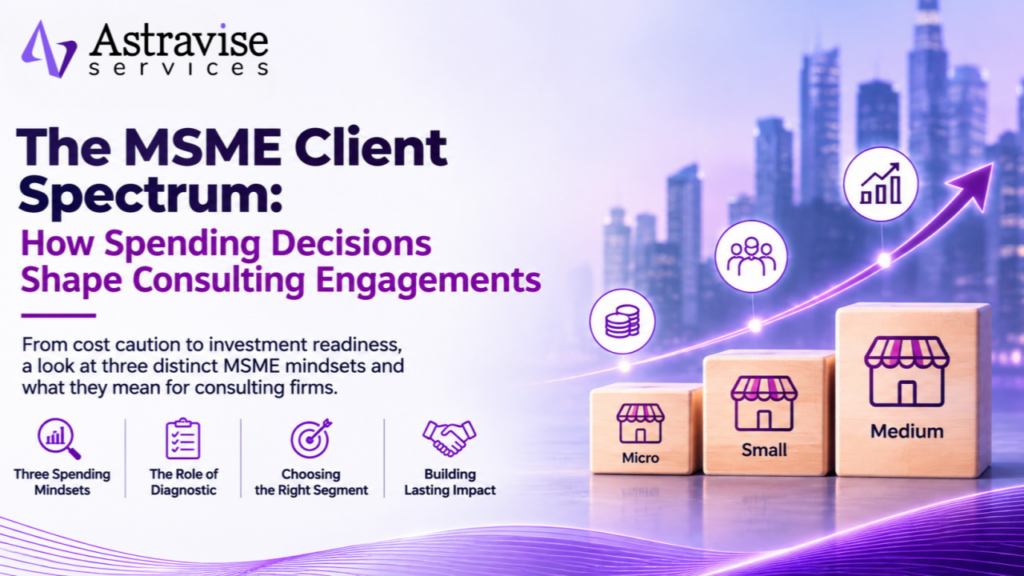
While these categories establish the scale of an enterprise, they do not necessarily indicate how its promoters approach professional services. Based on our experience working with businesses across industries and stages of growth, three distinct spending mindsets emerge within the MSME ecosystem.
Three Spending Mindsets Within the MSME Sector
| Spending mindset | Businesses commonly associated with it | Approach to professional services | Consulting requirement |
| Cost-Conscious | Predominantly Micro | Lowest-cost preference; limited willingness to invest | Essential support and cost-efficient interventions |
| Value-Conscious | Mix of Small and Medium | Willingness to invest when value and affordability are established | Focused assessments and phased interventions |
| Investment-Ready | Predominantly Medium | Recognises professional expertise and expects strong delivery | Detailed diagnostics, senior expertise and implementation support |
1. The Cost-Conscious Business: Every Expense Is Negotiated
This group approaches professional services primarily through the lens of cost. The preference is to secure accounting, taxation, HR, compliance or consulting support at the lowest possible price.
In our experience, over 90% of the micro enterprises we encounter fall into this category. Some operate under genuine financial pressure, while others have the capacity to spend but do not yet recognise the commercial value of professional support.
These businesses need professional advice just as much as larger enterprises. They may require better financial controls, cash-flow management, statutory compliance, structured HR practices or operational improvements. However, the perceived cost of engaging specialists often delays these decisions.
Micro enterprises willing to invest in professional services do exist, but they are the exception rather than the norm in our experience.
For consulting firms, this segment requires cost-efficient and clearly defined service models. A focused diagnostic can help identify immediate gaps, explain their business implications and establish which interventions are essential.
2. The Value-Conscious Business: Quality Matters, Affordability Still Matters
This group understands the importance of professional expertise, often after experiencing the limitations of cheaper service providers or inadequate solutions.
They are willing to invest in quality, provided the expenditure makes commercial sense. Working capital, operating expenses and other business priorities continue to influence their decisions. This segment includes a mix of small and medium enterprises.
Their requirements may range from stronger finance and HR functions to improved governance, compliance, process optimisation and technology adoption.
For consulting firms, a shorter, focused diagnostic is generally more appropriate. It should establish the primary problem, identify immediate priorities and recommend a practical course of action. A phased engagement can then help the promoter manage the investment while addressing the most important requirements first.
3. The Investment-Ready Business: Strong Expectations Around Delivery and Control
This group recognises the value of professional expertise and is prepared to invest in people, processes, technology, governance and organisational capabilities. Most medium enterprises we encounter tend to fit this category.
Price is generally less of a constraint, but expectations around delivery are considerably higher. Promoters seek regular progress reports, documented recommendations and visibility into each stage of the engagement. Some also expect consultants to work closely with internal teams or provide on-site implementation support.
For consulting firms, these engagements require a more detailed diagnostic covering organisational structure, financial performance, people practices, operational processes, governance and technology requirements. The assessment needs to establish the current position, identify interconnected gaps and develop a structured roadmap for implementation.
Choosing the Right Segment Is a Strategic Decision
For consulting firms, each spending mindset calls for a different commercial approach, service structure and delivery capability. A firm may be well equipped to serve cost-conscious businesses through standardised, cost-efficient services, while another may be better suited to value-conscious or investment-ready clients requiring deeper advisory and implementation support. Trying to accommodate all three segments without the necessary delivery model can stretch resources, complicate engagements and weaken market positioning.
Selecting a focus segment should therefore consider their expertise, delivery capacity, commercial model and ability to sustain the expected level of client involvement.
For MSME promoters, the decision to engage professional services also deserves a different perspective. Expenditure on external expertise should be evaluated through its potential return on investment and effectiveness. Better financial visibility, stronger compliance, improved processes, reduced operational inefficiencies and informed business decisions are outcomes worth considering when assessing the value of an engagement.
The Diagnostic as the Starting Point
A diagnostic assessment helps establish a common understanding of the business, identify gaps and evaluate the interventions required. Its depth should correspond to the organisation’s requirements, from a focused review of immediate priorities to a comprehensive assessment of business functions and long-term improvement opportunities.
At Astravise Services (ASPL), we work with businesses to assess their organisational requirements and strengthen the functions that support sustainable growth. Through strategic CFO advisory and CHRO advisory, business consulting and transformation support, we help promoters identify gaps, establish priorities and develop practical approaches to business improvement.
For MSMEs considering their next stage of growth, the important question is whether their current business structure, processes and capabilities are equipped to support it. A clear understanding of where the business stands is the starting point for deciding where professional expertise can create measurable value.
“The real gap is building the management capability amongst the entrepreneurs to learn how to solve business problems and make sound decisions using management science, using data, using change management and project management and cultural transformation principles.”
Samir Sathe: Executive Vice President, Wadhwani Advantage, Wadhwani Foundation [3]
If your organisation is evaluating its priorities or looking to strengthen its business functions, connect with Astravise Services at info@astraviseserv.com.
References
[1] Simply Wall St. Professional Services Industry Analysis and industry financial performance data.
https://simplywall.st/markets/us/industrials/professional-services
[2] Mordor Intelligence. Consulting Services Market: Industry Analysis, Trends and Outlook.
https://www.mordorintelligence.com/industry-reports/consulting-service-market
[3] Samir Sathe. How SMEs Can Grow by Consulting Themselves. Wadhwani Foundation, 28 June 2021.
https://wadhwanifoundation.org/pt/press/how-smes-can-grow-by-consulting-themselves/
[4] Ministry of Micro, Small and Medium Enterprises, Government of India. Notification S.O. 1364(E), 21 March 2025.
https://udyamregistration.gov.in/Circular.aspx