
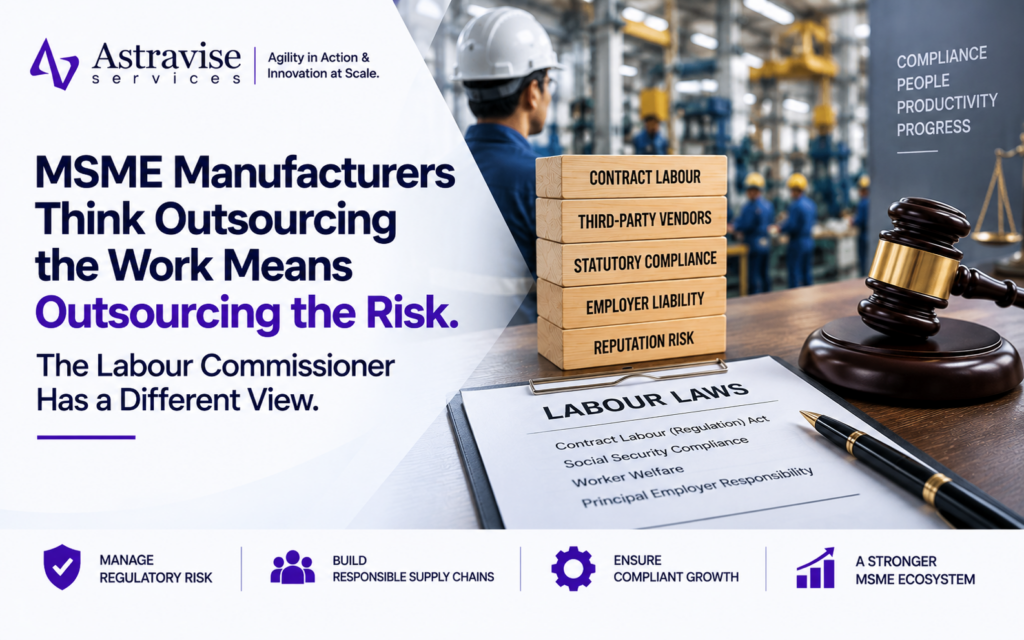
Part 3 of a three-part series on the people crisis in Indian manufacturing – the governance gaps inside outsourced and contract manufacturing, and why the organisations least visible on an org chart are often carrying the most risk.
There is a particular comfort that comes with outsourcing – and I understand it completely.
The headcount does not sit on your payroll. The compliance obligations feel like someone else’s calendar reminder. The contractor handles the workers, the wages, the provident fund, the ESI – and the principal employer gets the output without the overhead. For a growing MSME manufacturer trying to scale without adding fixed cost, it is a clean arrangement. It makes sense on a spreadsheet. It makes sense in a board discussion. It makes sense right up until the labour compliance notice arrives with your name on it for something that happened in a plant you visit twice a year.
The law does not read the contract the same way the finance model does.
Under the Contract Labour (Regulation and Abolition) Act, when a contractor misses a wage cycle, skips a PF contribution, or lets ESI lapse – the liability does not stay with the contractor. It transfers to the principal employer. The MSME owner who outsourced the work to reduce risk has, in practice, kept every bit of it. The contract said otherwise. The court does not care what the contract said.
India’s MSME manufacturers face over 1,450 regulatory obligations annually.[1] That number alone is the kind that makes a plant owner reach for a second cup of chai. What makes it genuinely alarming is that a significant portion of those obligations do not relate to what happens inside the principal employer’s own plant – they relate to what happens inside the contractors. The vendor-managed unit down the road. The outsourced assembly line that never appears on the org chart but whose workers, under the law, become the principal employer’s responsibility the moment something goes wrong.
When the Taggd India Decoding Jobs 2026 Report flagged the scale of the compliance gap across MSME manufacturing, the detail that stayed with me was not the headline number. It was the reason behind it. The core barrier is not intent. It is not even resistance. It is the simple fact that nobody formally owns the question – and in a contractor arrangement, that absence of ownership sits quietly in the background, unaudited and unaddressed, until a notice makes it loud.[1]
The people governance gap in outsourced manufacturing is the one that is hardest to see – because by design, the problem lives outside the building.
When the contractor’s compliance slips, the first signal is rarely the compliance notice. It is something quieter. A worker who stops showing up. A grievance that surfaces through an informal channel nobody was monitoring. A contractor who reassures everyone that everything is in order, with the same complete sincerity as the finance lead who described a seventeen-tab colour-coded Excel file as self-explanatory. It was not self-explanatory. And the contractor’s assurance is not an audit.
For most MSME organisations managing outsourced manufacturing, the honest answer to “do you know whether every contractor working on your behalf is currently compliant?” is some version of – we assume so, we have not checked recently, and we would not know where to start if we did. That assumption is not negligence. It is what happens when nobody in the organisation was ever formally given the mandate to own the question.
It is the organisational equivalent of subcontracting the electrical work on a building and assuming the safety certificate covers it. It does not. And the inspection does not care whose name is on the contractor’s agreement when the wiring is wrong.
This third challenge connects to everything Part 1 and Part 2 described – because it arrives at the same intersection.
Part 1 described the knowledge walking out the gate with retiring engineers – institutional memory disappearing because no structure was built to capture it before the last Friday of someone’s career. Part 2 described the next generation looking at a manufacturing career and choosing the IT park forty kilometres away with the hybrid work policy and the cafeteria that does not smell like cutting fluid.
When the core workforce is aging and the pipeline is thin, the instinct is to fill the gap with contract labour and outsourced arrangements. That instinct is not wrong. The execution almost always is – because the compliance framework around it never gets built with the same urgency as the production schedule it is meant to support.
Contract labour fills a vacancy. It does not fill the governance gap around it. And in 2026, with BRSR disclosures pulling supply chain governance into public view and labour compliance audits becoming considerably more active than they were two years ago, the gap is becoming harder to carry quietly.[2]
The organisations getting this right have done something that sounds straightforward and rarely is in practice – they have extended the mandate of the people function beyond the boundary of their own org chart.
Contractor compliance reviews built into the procurement cycle rather than triggered by a notice. People governance frameworks that treat the workers producing output for the organisation as the organisation’s responsibility regardless of whose payroll they sit on. Clear accountability for what happens when something goes wrong – assigned before it goes wrong, not in the three panicked days after.
None of this requires a large team. It requires the people function to have the standing to ask the question and the mandate to act on the answer before the labour commissioner asks it first.
Three parts. Three challenges. One thread running through all of them.
The knowledge walking out with the retiring engineer. The next generation choosing not to walk in. And the contractor’s workers producing output for the organisation while the compliance risk sits quietly in the background, unowned and unaudited, until it is not quiet anymore.
In each case, the people function had the tools to prevent what became expensive. What it did not have was the mandate to use them early enough.
That is the real crisis in Indian MSME manufacturing. Not the market. Not the competition. Not even the talent shortage, as real as it is. The consistent, structural absence of a people function with the authority to get ahead of problems that are entirely visible – if someone is formally looking.
The silver tsunami arrived. The pipeline started running dry. The contractor’s compliance notice landed on the wrong desk.
Three different problems. Three different moments. The same missing mandate every time.
Astravise Services works with MSME manufacturing and engineering organisations through Strategic CHRO Advisory – helping leadership build the people infrastructure, governance frameworks, and compliance architecture that ensures the organisation is not discovering its risks in the worst possible way at the worst possible time.
📩 info@astraviseserv.com | astraviseservices.com
This article is intended for informational purposes and reflects the analytical perspective of Astravise Services. Statistical data cited is drawn from publicly available third-party research.
References
[1] India’s MSME Compliance Problem Is Not Resistance — It’s Awareness | SME Futures, 2026 | smefutures.com
[2] MSME Supply Chains & BRSR 2026: Where Compliance Breaks | EHSSaral | ehssaral.com