
Part 2 of a three-part series on the people crisis in Indian manufacturing – why the next generation of talent is not choosing the shopfloor, and what the people function needs to do before the pipeline runs dry.
Every conversation about India’s manufacturing ambition eventually arrives at the same point – the investment is real, the capacity is being built, the PLI schemes are working, and then someone in the room quietly asks who is going to run the plant. The question hangs there for a moment. Then the conversation moves on, because nobody has a comfortable answer and there is a slide deck to get through.
That question does not go away just because the meeting ended.
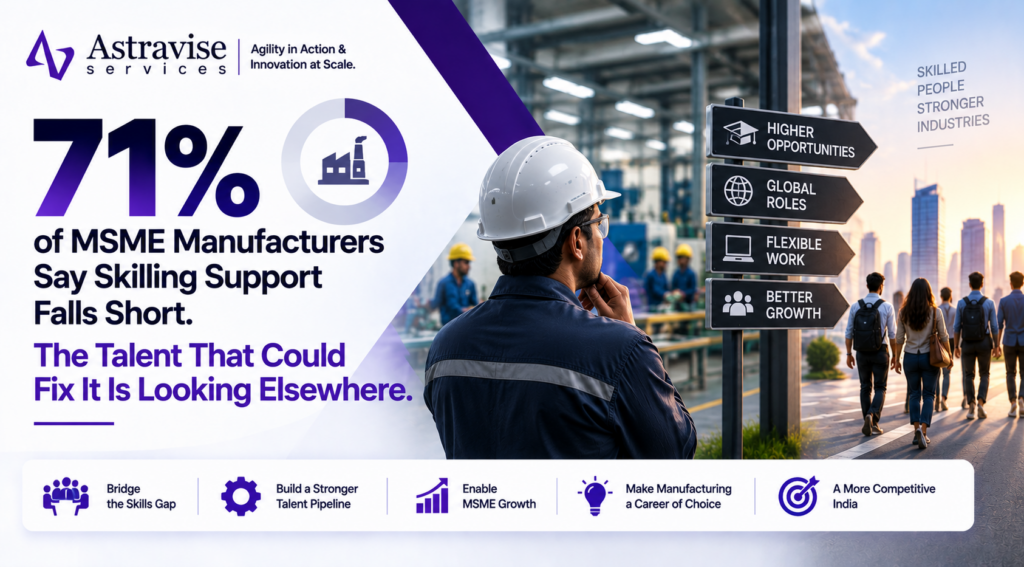
When the Taggd India Decoding Jobs 2026 Report landed earlier this year, one number stopped me more than any other. 71% of MSME manufacturers say current skilling support falls short of what their operations need.[1] Not a rounding error. Not an outlier. Nearly three quarters of the sector admitting, with the kind of quiet resignation that comes from having tried the existing options, that the infrastructure to build the workforce it needs does not yet exist.
Here is what makes this harder than it looks on a hiring dashboard.
The most valuable manufacturing professional in 2026 is not the person who can run a single machine competently for eight hours and hand over to the next shift. It is the person who understands the machine, the data it produces, the process it sits inside, and the system that connects it to everything else on the floor. Someone who can read a PLC output and a data analytics report in the same morning and know what both are telling them. That profile – mechanical fluency combined with AI literacy – does not naturally turn up in the applications for a role posted on a job portal with a title that has not been updated since 2019 and a job description that lists twelve requirements, eight of which contradict each other.
88% of manufacturers say attracting the next generation of talent is a high or very high priority.[2] Three in four of them admit they are struggling to do it. The gap between those two sentences is where the people function has been absent – and where it needs to show up with a different kind of mandate than it currently has.
The geography problem is the one that does not get spoken about honestly enough – because it is uncomfortable for organisations that have already committed to a location.
Manufacturing talent clusters around cities, around the places where career options feel visible and career moves feel possible. The new industrial corridors that PLI investment is opening up are often in locations where none of that exists yet. The plant is there. The investment is there. The talent that could make it run at the level the investment deserves has looked at the location, looked at what else is available, and made a decision that did not involve that corridor.
An MSME manufacturer in a newer industrial cluster is not just competing with the plant down the road for the same candidates. It is competing with the IT park forty kilometres away that has a cafeteria and a hybrid work policy. It is competing with the GCC that just opened in the nearest tier-two city and is offering structured career frameworks and international exposure. It is competing with the gig economy, which offers something no shift-based manufacturing role has historically offered – the ability to decide on a Tuesday morning that today does not feel like a full day.
The twenty-four-year-old with exactly the right skills is making a career decision. And the factors going into that decision – career visibility, learning pathways, the sense that the organisation is going somewhere worth going – are ones most MSME manufacturers have never formally addressed because nobody in the organisation was ever given the mandate to address them.
The annual appraisal cycle does not cover this. The recruitment vendor does not cover this. The compliance training that everyone completes in forty minutes on a slow Friday and forgets by Monday does not come close.
The organisations getting this right are not necessarily the ones with the largest budgets or the most recognisable names. They are the ones where the people function has been given permission to ask a different set of questions before the vacancy opens.
What does the career path look like for someone who joins this plant at twenty-two and is still here at thirty-two – and is there actually a path, or just a series of roles that nobody has connected into a story worth telling? What does the employer brand say to someone who has never heard of this organisation and is comparing it against four other offers on the same afternoon? What learning infrastructure exists beyond the safety induction that nobody remembers, and the toolbox talks that happen because they have to?
These questions do not get answered by a job portal. They get answered by a people function that has the mandate, the seniority, and the standing to treat talent attraction as a design problem – and that starts asking the questions six months before the position needs to be filled, not six days after the previous person handed in their notice.
The pipeline is not going to fill itself. And the talent that could fill it is making its decision right now, based on what it can and cannot see about its future in this sector.
Part 3 examines the third challenge compounding this crisis – the people governance gaps inside outsourced and contract manufacturing, and why the organisations least visible on an org chart are often the ones carrying the most risk.
Astravise Services works with MSME manufacturing and engineering organisations through Strategic CHRO Advisory – helping leadership build the talent attraction frameworks, career architecture, and people infrastructure that gives the next generation a reason to choose manufacturing.
📩 info@astraviseserv.com | astraviseservices.com
This article is intended for informational purposes and reflects the analytical perspective of Astravise Services. Statistical data cited is drawn from publicly available third-party research
References
[1] Taggd — India Decoding Jobs 2026 Report | taggd.in
[2] UKG & IndustryWeek — Future Manufacturing Workforce Study | businesswire.com
[3] Manufacturing Today India — India Manufacturing Workforce in Review 2025 | manufacturingtodayindia.com